
The Expanding Language of Fiber
At some point, fiber art quietly slipped past the boundaries people tried to place around it. What was once expected to be soft, woven, domestic, functional, or even recognizable as cloth has expanded into something much harder to define.
Contemporary fiber artists now work with steel mesh, silicone, monofilament, rubber tubing, magnetic tape, industrial felt, vinyl, taxidermied hide, plastic fencing, and other materials that seem to resist the category entirely.
Some pieces drape like fabric but contain no traditional fiber. Others are technically woven or stitched, yet resemble architecture, skin, erosion, armor, or biological specimens more than anything we instinctively think of as textile. Somehow, we still recognize them as part of the same language.
I keep returning to the question: what actually makes something fiber art?
Is it the material itself? The process? The structure? The relationship to the body? The visible labor? Or is it something more instinctive than that, something we humans recognize before we even have words for it?
The more contemporary fiber expands, the less stable the answers become.
For a long time, the definition seemed relatively straightforward. Textiles were woven, stitched, felted, braided, and knotted. Fiber meant thread and cloth, pliability and softness. But contemporary artists seem increasingly uninterested in preserving those clean boundaries. I think that resistance is part of what makes the field feel so alive right now.
Leather complicates the conversation almost immediately.
It’s organic, flexible, wearable, sewn, folded, stretched, deeply tied to textile traditions, and historically inseparable from garment making. Yet technically, it isn’t fiber. It’s skin. So where does it belong?
And once leather enters the conversation, the line starts dissolving quickly.
What about woven copper mesh that folds like cloth? Chainmail that drapes over the body like fabric? Silicone stitched together until it resembles flesh more than textile? Animal hide sewn into sculptural work? Synthetic turf woven into tapestry structures?
So many questions.
At what point does material stop mattering? Or maybe the better question is: did it ever matter as much as we thought it did?
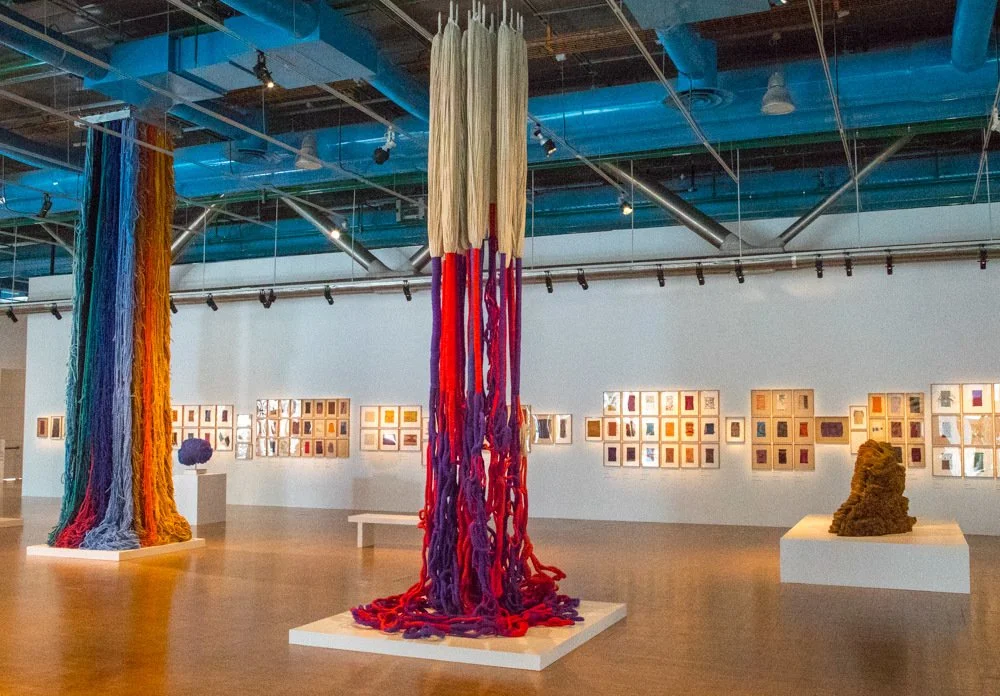
From the collected works of contemporary fiber artist Sheila Hicks
Artist Sheila Hicks often speaks about fiber as language rather than category, and I think that framing opens something important. Hicks has worked with linen and wool, but also industrial cordage, found materials, synthetic elements, and objects that move freely between sculpture, installation, architecture, and textile.
Language evolves the moment people start using it differently.
It absorbs slang, disruption, misuse, regionalism, and internet shorthand. Words once considered “incorrect” eventually become accepted through repetition and cultural adoption. A phrase like “six seven” embeds itself into collective vocabulary not because anyone formally approved it, but because enough people understood and agreed upon the rhythm or meaning behind it.
Fiber feels similar to me.
Once enough artists begin weaving with wire, stitching silicone, knotting industrial plastics, or constructing textile forms from materials historically excluded from the category, the language itself begins stretching to accommodate them. Not because museums allow it, but because the work insists upon itself.
Interestingly, humans still respond to these works as textile.
A woven steel structure feels fundamentally different from a sheet of metal. A stitched silicone form feels strangely bodily in a way molded plastic doesn’t. Repetition, interlacing, drape, compression, tension; these things communicate something ancient to us regardless of whether the material came from sheep, petroleum, roadwork, or a hardware store clearance bin.
Maybe fiber art has less to do with purity of material and more to do with relationship.
One thing passing through another. Another structure holding tension. A surface built slowly through accumulation and touch.
Taxidermy creates another fascinating edge case.
Most people would classify taxidermy as preservation or sculpture rather than fiber art, but historically the separation becomes harder to defend the longer you sit with it. Hide sewing, stitched pelts, fur garments, sinew thread, woven hair, and animal-based textile traditions have existed for thousands of years.
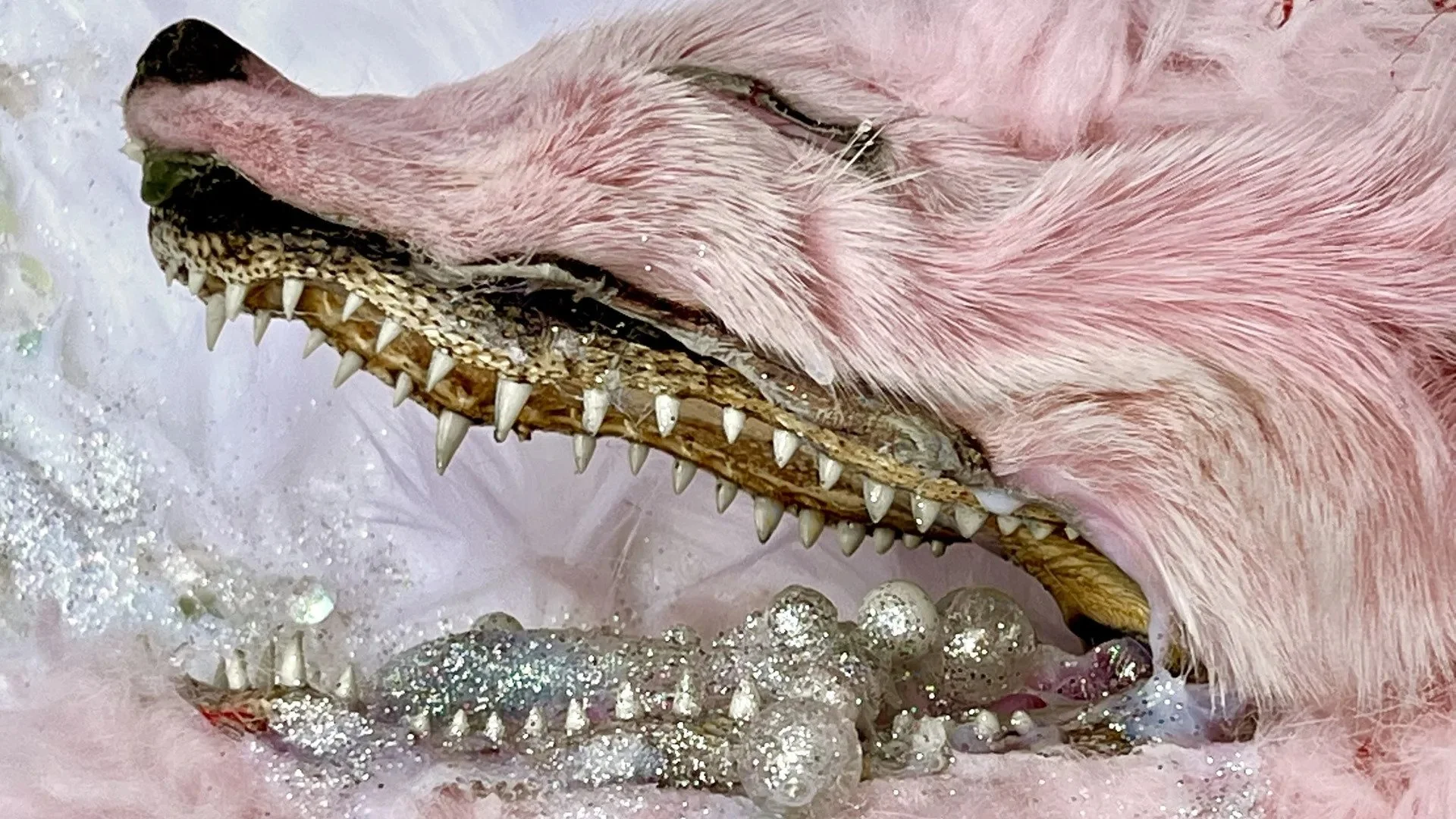
Kelly Boehmer, Drool (detail), 2022. 46cm x 61cm (18″ x 24″). Hand stitch. Taxidermy, acrylic, faux fur, real fur, beads, glitter, organza, yarn, canvas. Image from textileartist.org
Contemporary artists working with hide, bone, fur, or preserved animal material often unsettle viewers precisely because they collapse distinctions between cloth and body, softness and mortality, textile and flesh. Artist Kelly Boehmer works in atypical fiber media to convey themes of anxiety, growth, and death.
The discomfort becomes part of the work itself. I think that discomfort matters.
Fiber art has long been dismissed as safe, decorative, domestic, feminine, soft. But contemporary textile work increasingly refuses those expectations. It can feel industrial, uncanny, confrontational, mournful, biological, even grotesque. It can behave more like architecture or skin than cloth.
Still, the language remains recognizable somehow, maybe because textile processes leave evidence behind in a way few other mediums do. Textiles usually reveal how they came into being. You can trace the movement. The labor remains visible in a way not often readily apparent in many art forms.
The body remains visible.
Maybe that’s why humans continue responding so instinctively to textile structures, even highly experimental ones. We recognize tension, repair, compression, fragility. We recognize accumulation. We recognize touch.
Museums and galleries have begun embracing this expanded definition of fiber more openly, exhibiting works that move fluidly between sculpture, installation, textile, and material experiment. Contemporary fiber shows increasingly include industrial materials, synthetic forms, digital fabrication, found debris, biologically ambiguous structures, and work that would have been excluded from the category entirely a few decades ago.
I’m less interested in institutional validation than I am in the questions these works continue to raise. What makes something textile? Can a material behave like cloth without technically being cloth? If something is woven, does that matter more than what it’s woven from?
And why do we remain so emotionally responsive to interlaced structures, even when the materials themselves feel cold, synthetic, or unfamiliar?
I don’t think there are clean answers. Honestly, I hope there never are, or if so that we continue chasing the answers with further questioning. Something about the uncertainty feels deeply human to me, much like fiber art at its best: adaptive, relational, impossible to pin fully into place.
