

Selvage Notes
A Maker’s Journal
Exploring fiber arts, material culture, and the creative life.
Nothing Changes. Everything Changes.
And just like that, life is filling up again!
There are projects and people, plans and deadlines, things I want to make and things I want to learn. I’m preparing work for a new shop page, planning a local weaving class, building websites and—for reasons that made no sense when I started—learning to play the ukulele while singing.
Not long ago, I wrote here about convalescing through a season of mourning and change. The world had become big, my life grew smaller in response, and for a while I was content to let it.
I painted, wove, walked, and tried to pay attention to whatever was immediately in front of me.
Then a week or so ago I lit a candle, gave thanks for the time to grieve and heal, and welcomed the now-stagnant energy to go ahead and move on to someone who needed it.
And just like that, life is filling up again!
There are projects and people, plans and deadlines, things I want to make and things I want to learn. I’m preparing work for a new shop page, planning a local weaving class, building websites and—for reasons that made no sense when I started—learning to play the ukulele while singing.
¯\_(ツ)_/¯
Then I found some old photographs, and suddenly everything made sense again.
In one, I’m sitting with a guitar sometime in the 1990s, apparently convinced I might learn to play it. (I didn’t)
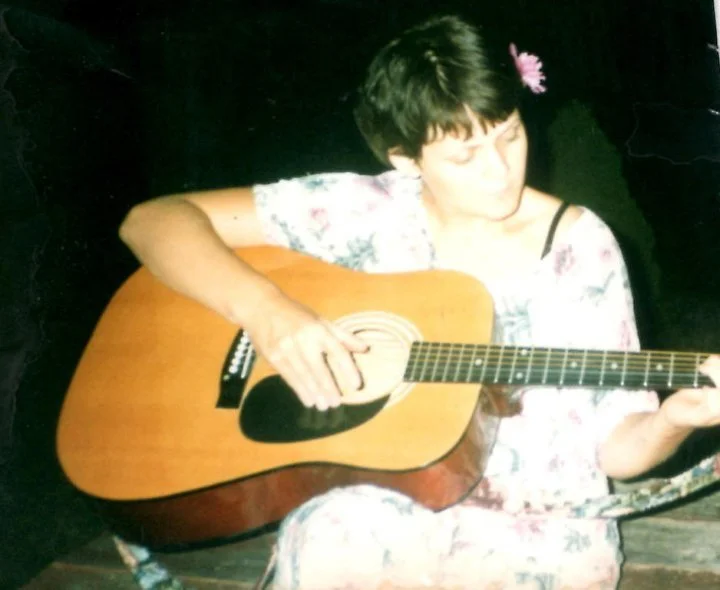
Peak 1990s 🌸
In another one taken over a decade later, my daughter and I are wearing masks we made together.
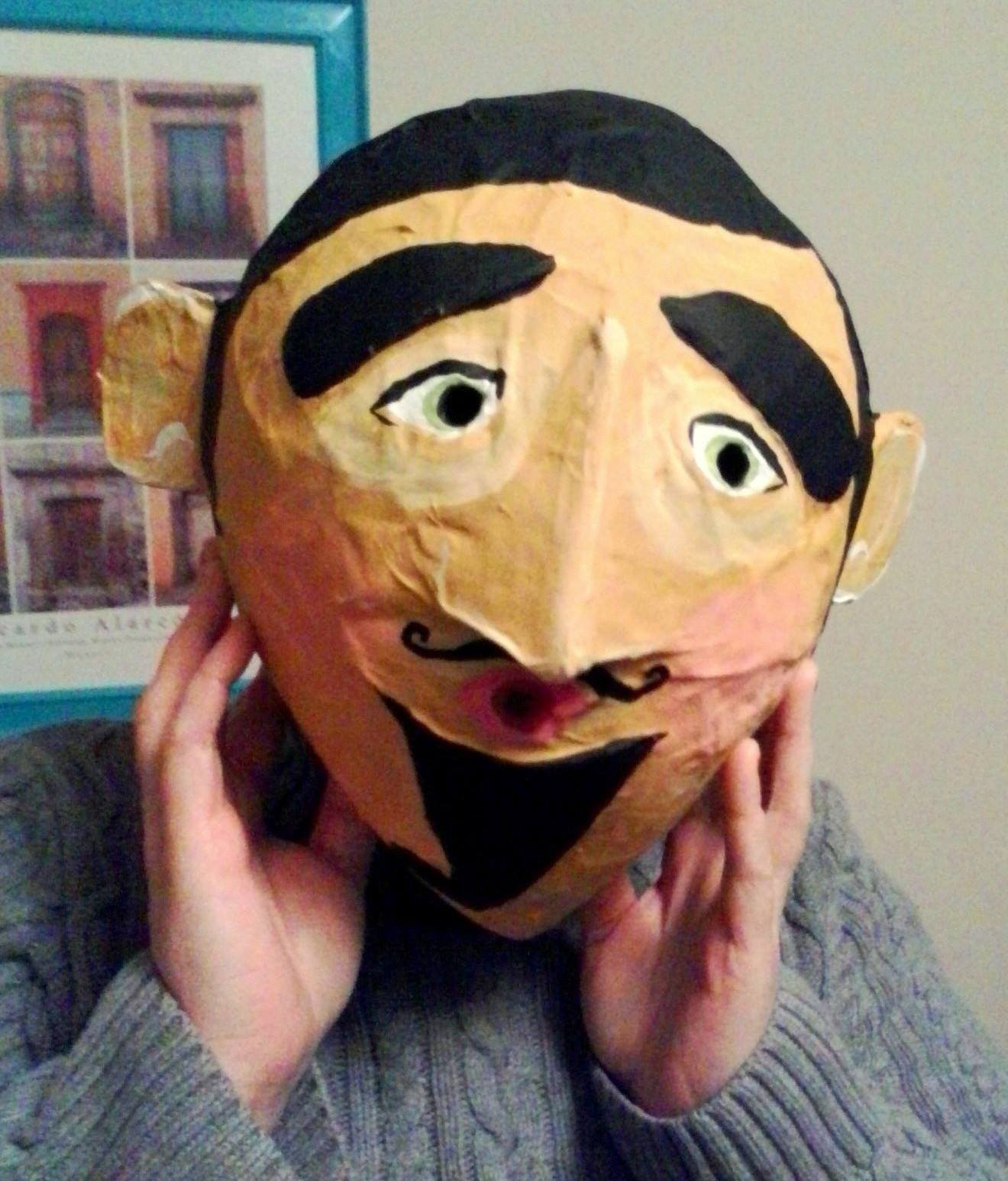
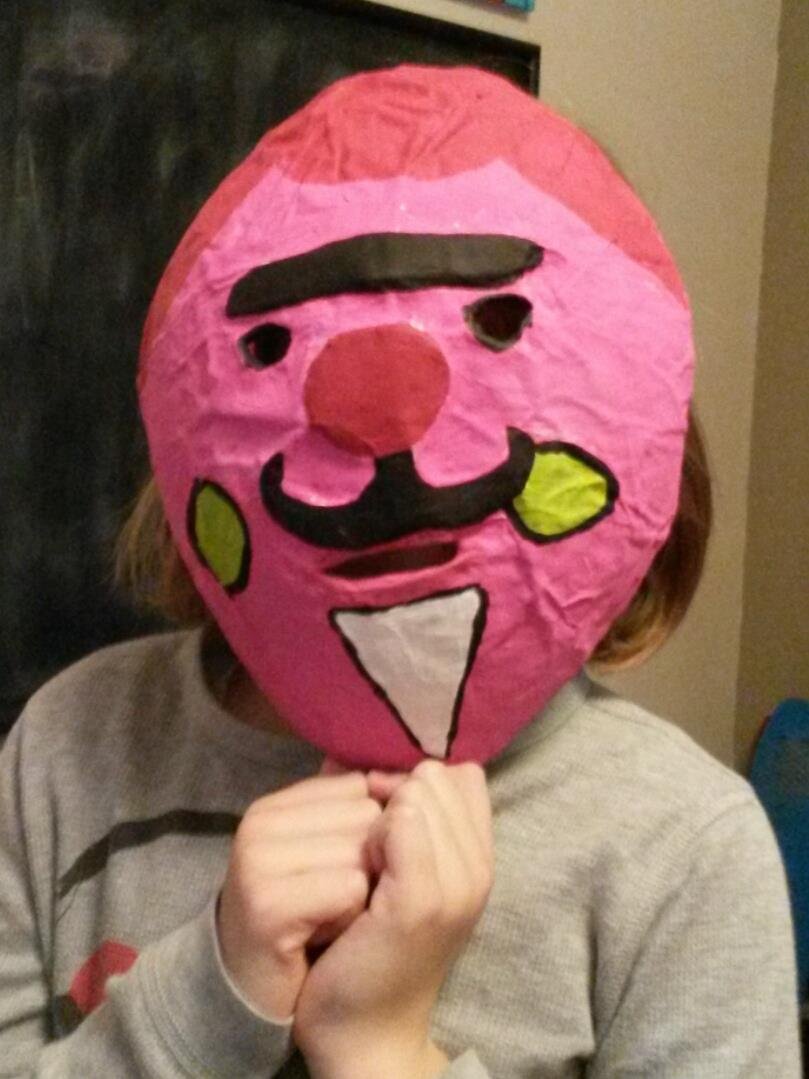
Masks, circa 2010
I was reminded of these during a recent conversation with her when we commiserated over having too many interests and only 24 hours in a day.
She is an adult now, a junior in an arts college taking classes on bookmaking and ventriloquy. Go figure.
In another pic, I’m taking a self-portrait in a mirror with a Polaroid camera.
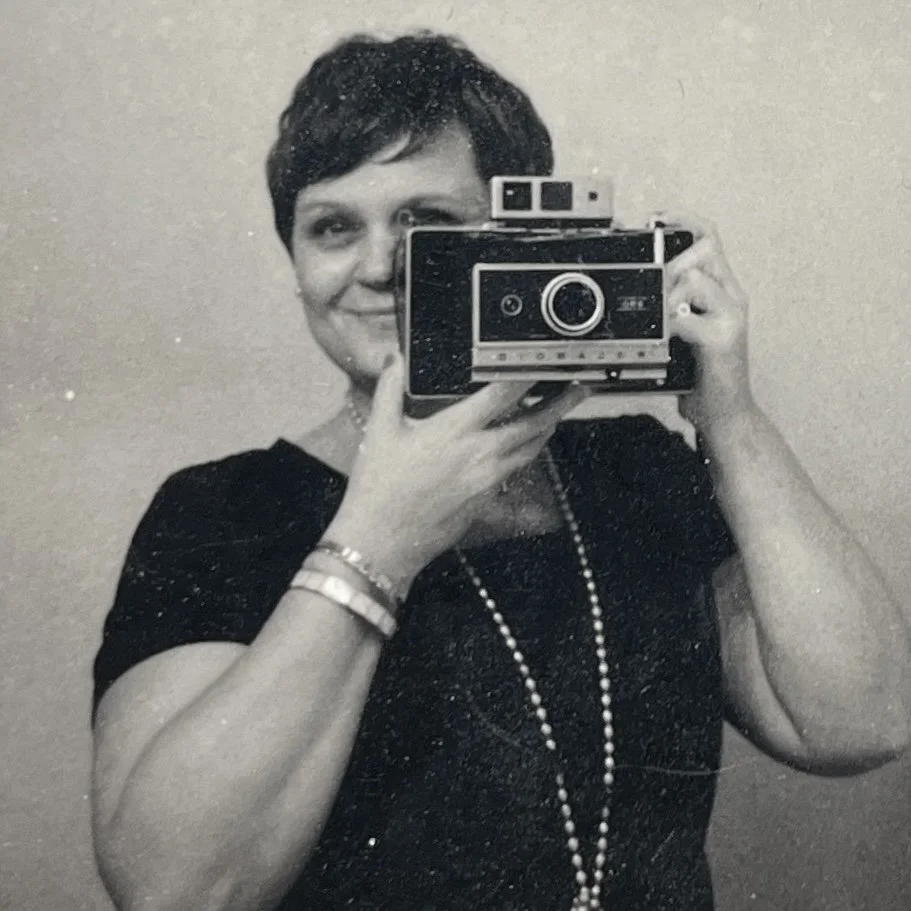
Self-portrait circa 2012
I kept looking at these seemingly disparate images and thinking the same thing.
Nothing has changed. Everything has changed.
Thirty years have passed since I strummed a few chords on a backyard picnic table outside State College, PA, and yet here I am still picking up unfamiliar instruments.
I’m still making things simply because I want to see what happens. I’m still interested in photographs and materials, in learning how things work, and in putting things together in ways they weren’t necessarily intended to go.
Most of all, I’m still following my curiosity wherever it leads.
Paying attention, still (again?)
I’ve been painting a lot lately.
Watercolor came into my life during that smaller season, when quiet and concentration were useful things. I’m still painting and steadily improving.
Though improving may be less interesting than what happens when you stay with something long enough to become curious about it. Ordinary subjects have become surprisingly worthy of consideration.
A banana can occupy an afternoon.
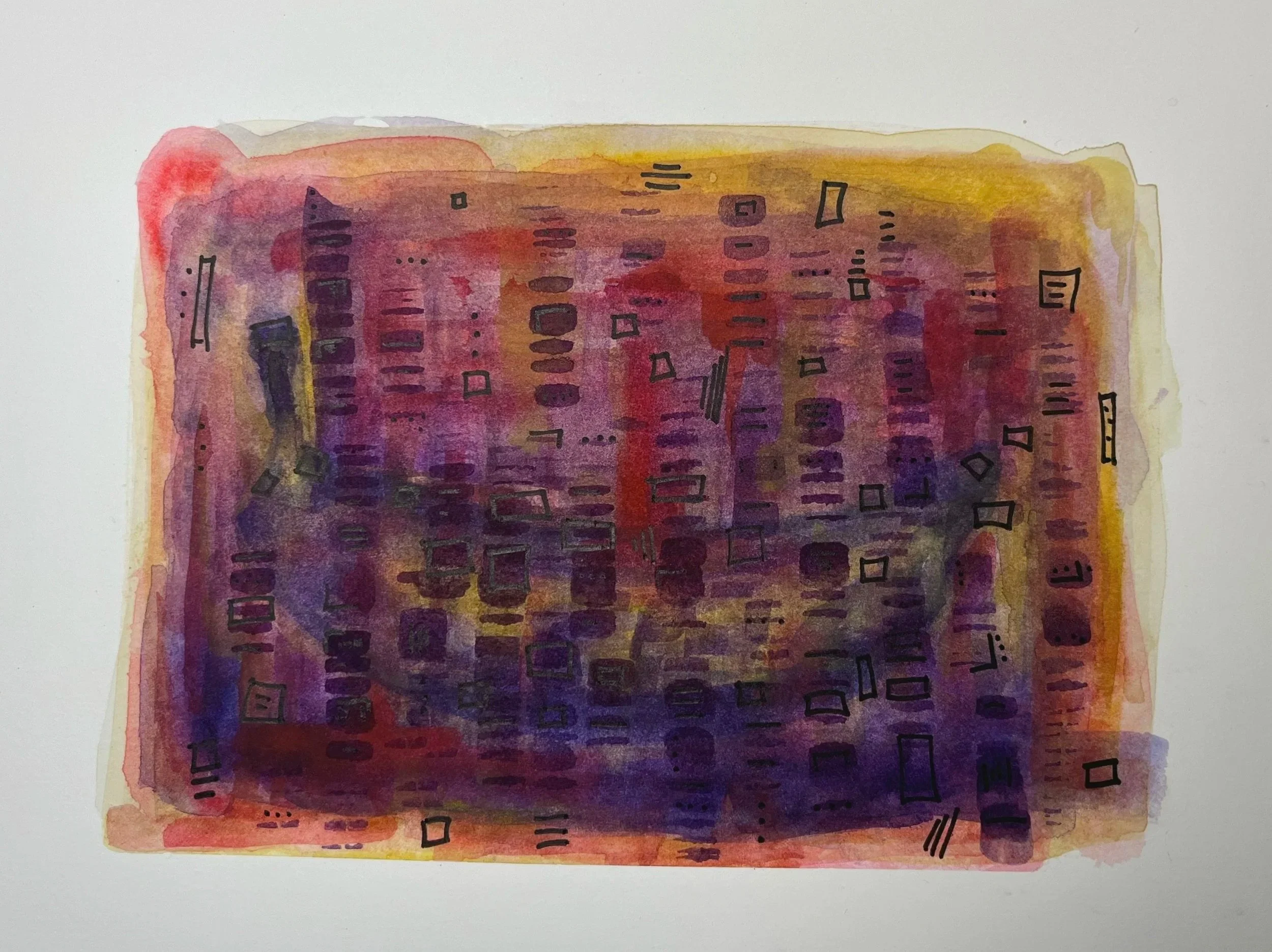
Pattern Recognition
Watercolor & Ink
So can a Texas red-headed centipede.
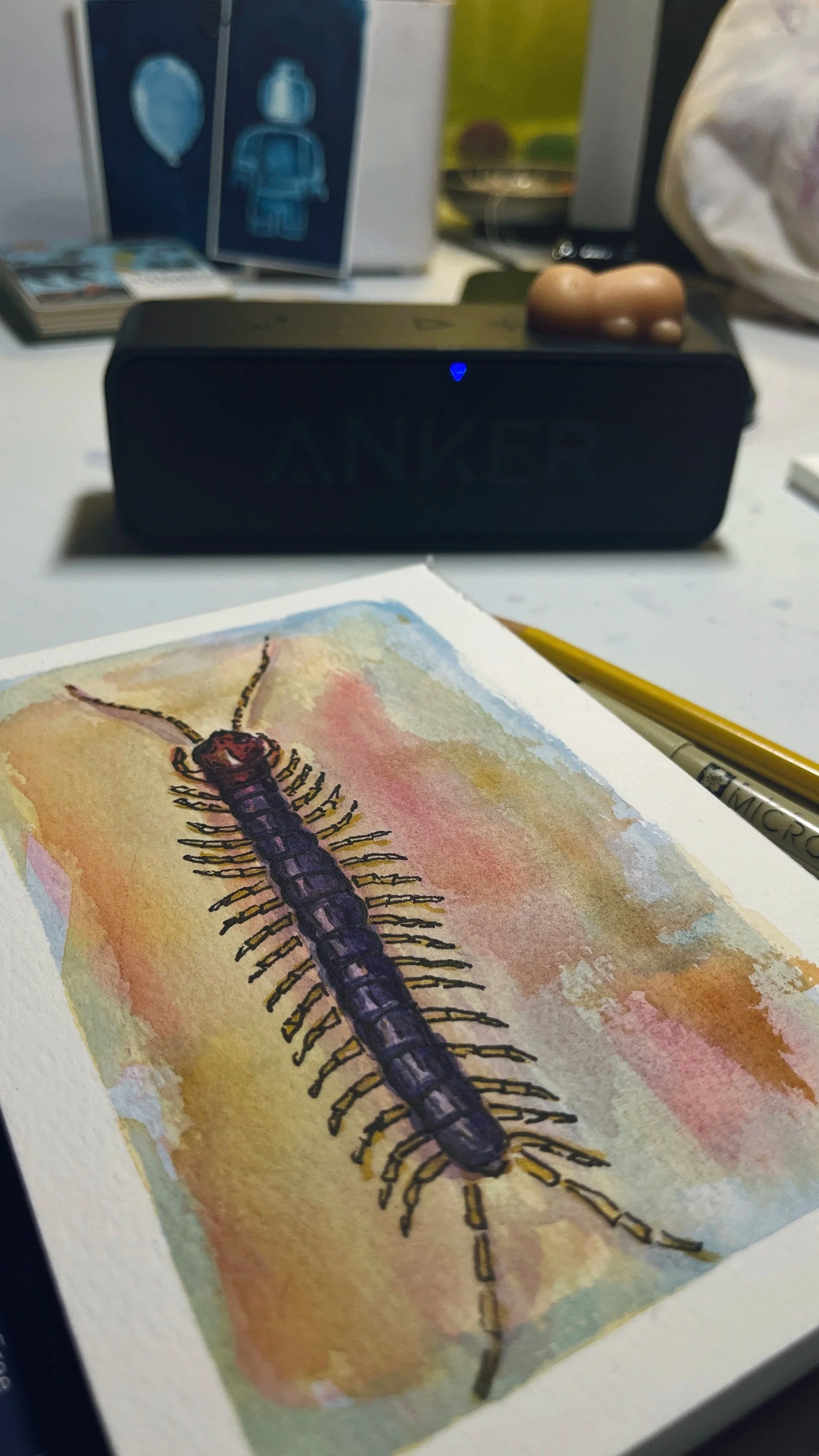
Red-Headed Centipede
Watercolor & Ink
(fun faux-cyanotype watercolor studies in the background)
Some paintings and other goods will soon find their way into my little shop. I like that something I began without any particular destination is slowly making its way out into the world.
My weaving has been doing the same.
One of my pieces is currently hanging downtown as part of a small local art crawl and auction fundraiser. I’m participating as an artist, but I also helped organize the event and built the Givebutter site that will carry the auction online.
I recommend perusing! We have some talented local artists.
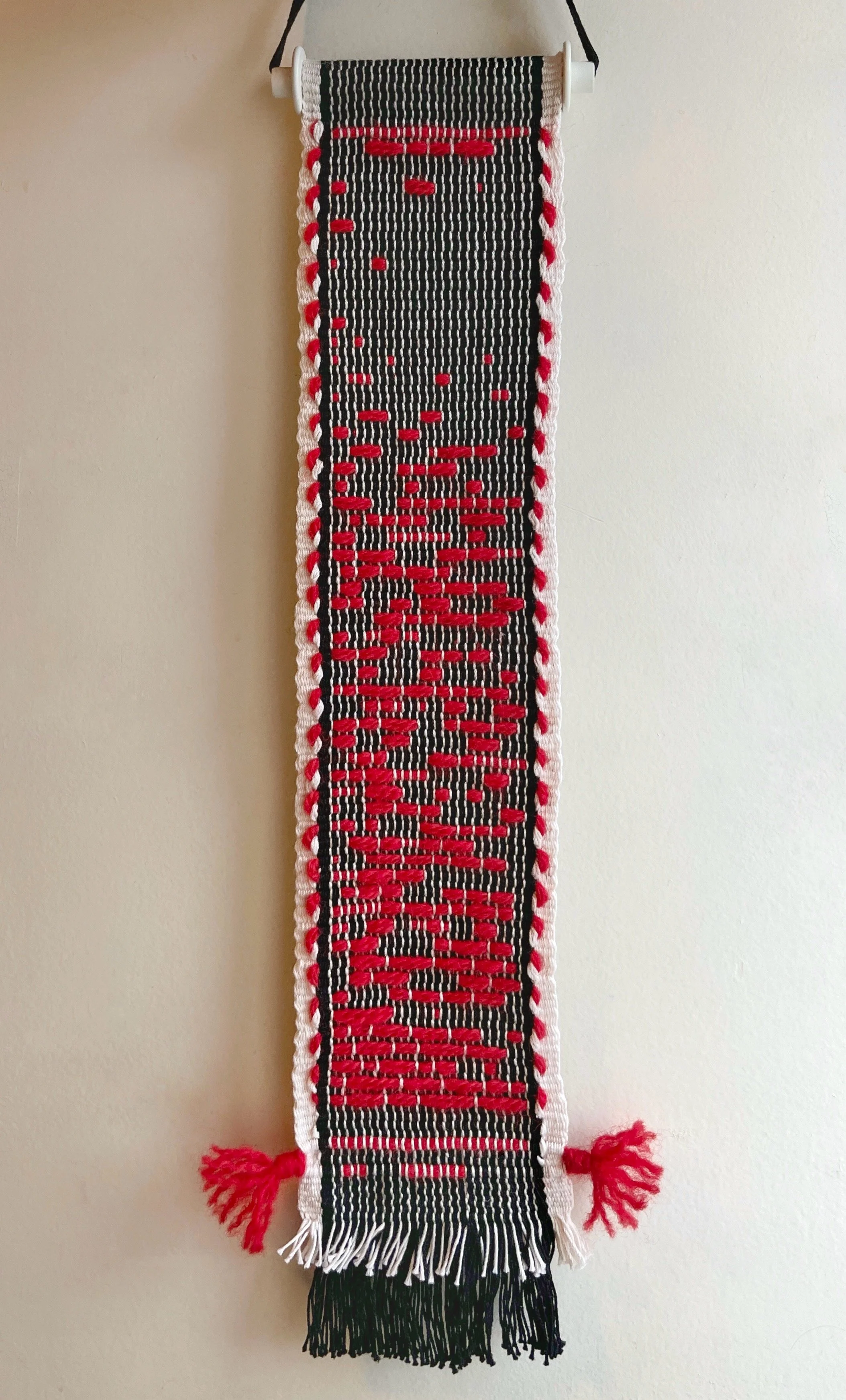
In Black & White: The Receipts
Cotton & wool
Auction link
Currently exhibited at John Ryan Brewery in Williamsport, PA
There is something satisfying about occupying both sides of that process. I made one of the objects, but I also helped build the place where my work and the work of other local artists can be seen, understood and eventually carried away by someone else.
The loom and the website are very different tools, but both begin with much the same question: What am I trying to say, and how do I help someone else find their way into it?
Storytelling
I’ve spent the past few weeks building a website for a local woodworker. He lives and works not far from me, and when we started talking the request was pretty straightforward: he needed an updated website.
That was no lie, but the more we talked, the more there was to tell.
The furniture and cabinetry were only part of it. There was also the family farm and the woods he grew up exploring, a sawmill, a kiln and a workshop. Decades of accumulated knowledge, an instinctive understanding of wood, and an unusual ability to move between architectural precision and making something with his hands.
None of this was presented to me as a story. It came out gradually, in conversations about the work, the farm, how he approaches a problem by “thinking in AutoCAD” and why he does certain things the way he does. It came out in the venison, peppers and turkey he fed me during our meetings—all straight from his farm—and in the little “Walnut Grove” our families picnicked in together that he had tended from saplings.
The story was already there. I just had to notice it.
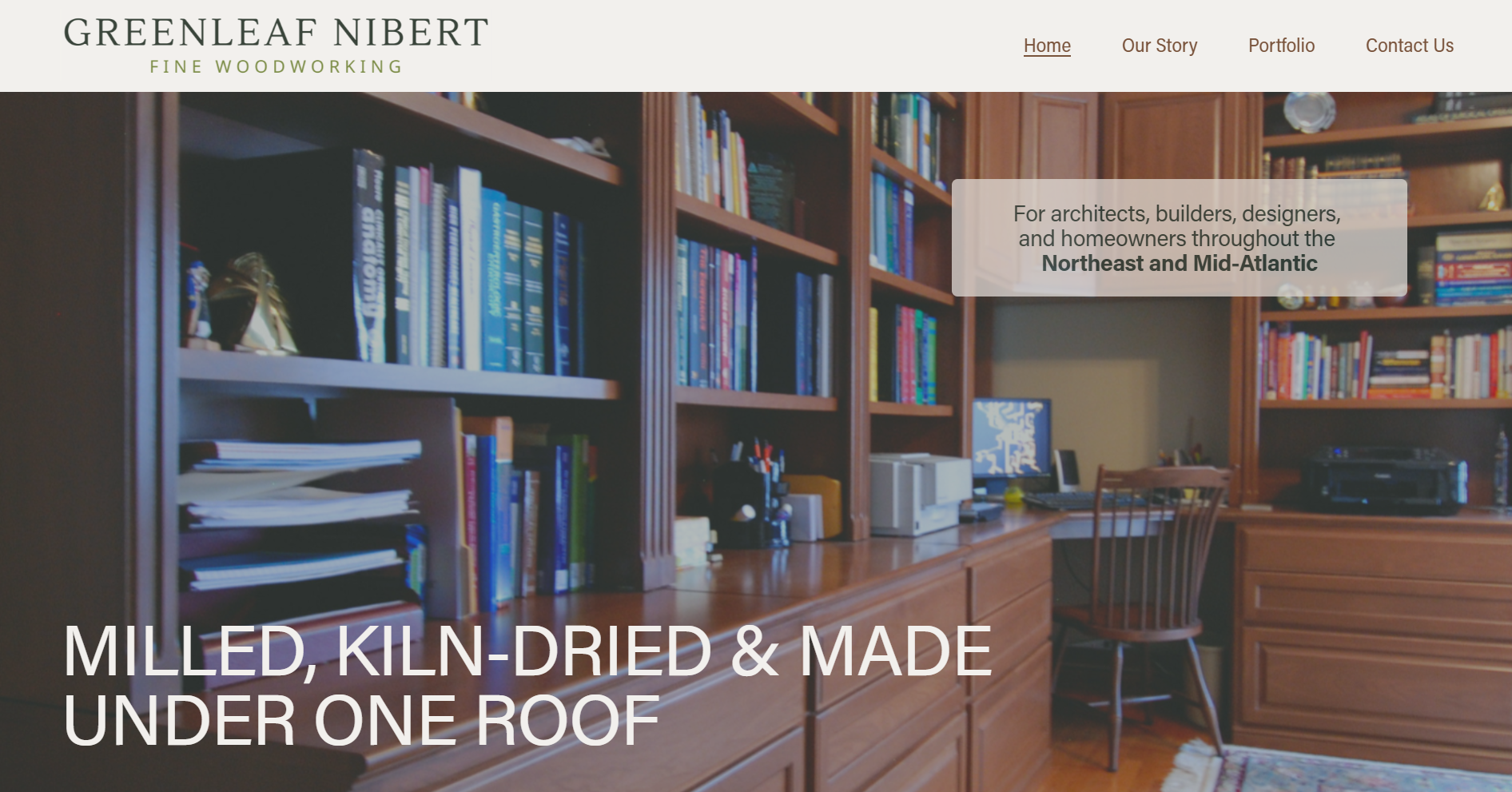
Greenleaf Nibert website, built for owner John Nibert
From there came the photographs, writing, typography, color, navigation, search and technology that turn all of those pieces into a website.
Those are the tools, but they aren’t really why I enjoy the work.
What I enjoy is getting to know someone and what they make, asking questions, noticing the things they might not think to mention or highlight, and finding the thread that connects it all.
Then I get to build a place where other people can discover that story, too.
Continuity
Looking at those old photographs, I realize I’ve been doing some version of that all along. The materials and circumstances change, but the impulse to pay attention, follow curiosity and make something from what I find has been remarkably consistent.
Maybe that’s why I enjoy building websites for creative people. The most interesting part is rarely choosing the right typeface or arranging photographs on a page.
It’s listening long enough to understand what someone does, why they do it and what makes their work distinctly theirs.
If you’re an artist, maker, author or small creative business with a body of work or a story that needs telling, I’d love to hear about it.
Touch-Me-Not
I was fifteen, living in a new town—a village, really—waiting for the bus at an overgrown stop I'd later learn nobody actually used. The village sat on the banks of the Susquehanna, and across the water rose the twin cooling towers of a nuclear power plant, quietly venting steam into the morning sky.
I was fifteen, living in a new town—a village, really—waiting for the school bus at an overgrown stop I'd later learn nobody actually used. The village sat on the banks of the Susquehanna, and across the water rose the twin cooling towers of a nuclear power plant, quietly venting steam into the morning sky.
I stood there alone, early and a little anxious on an ordinary morning, the way you are when you're new someplace and haven't yet learned its rhythms.
Out of curiosity, I reached over and touched a seed pod on a plant growing beside the stop.
It burst instantly, curling back on itself and scattering seeds across my hand. It startled me so completely that I laughed out loud.
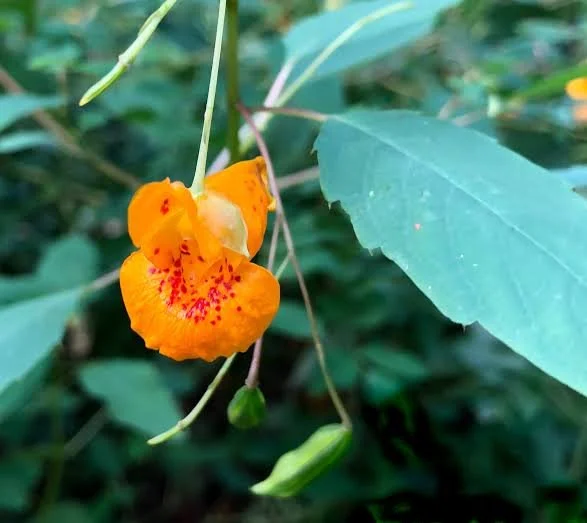
Jewelweed, AKA touch-me-not
I didn't know the bursting plant was jewelweed then, only that something had been holding so much tension in a very small package that the lightest touch was enough to undo it.
I think about that morning often now, though not for the reasons I would have guessed at fifteen. What stays with me isn't the jewelweed so much as everything around it: the waiting, unanswered questions, unfamiliar territory, and the enormous unseen power humming nearby.
A Season of Mourning
There are seasons (yes, I still say seasons without cringing) for all of us when the heart feels much like that seed pod, drawn so tight that even the gentlest touch threatens to release what we’re desperately trying to hold together. When so much is happening beneath the surface that there's very little room left between feeling and expression.
For me, this has been a season of mourning.
I’m mourning lost people and lost relationships, yes. Other losses, too. The kind that receive no flowers or formal acknowledgment. The kind you’re just meant to get over. You may know about this.
We grieve futures that quietly disappear, identities that no longer fit, and certainties we didn't realize we leaned on until they were gone. Sometimes we even grieve the life we imagined we'd be living by now.
These losses don't announce themselves; they accumulate, and one day you simply notice that the world has become unfamiliar. That you are, in some sense, fifteen again, new to a town you didn't choose, waiting at a stop whose schedule you don't yet know.
Power plants are strange neighbors. You live beside one and mostly forget it's there until some part of you registers, again, that a controlled, tremendous force is sitting just there, just across the river, doing its quiet work whether or not you're paying attention.
For me at least, grief seems to operate in much the same way. It hums in the background, shaping my emotional landscape even when I am not looking directly at it.
I've stopped trying to hurry past any of this, or bury it. Instead, I've become interested in what it's asking of me.
Making It Make Sense
For the past week, my little loom has held the first piece in a new series I've titled In Black & White.
Each weaving begins with the same neutral warp and explores in vivid color a different stage of love in some of its beautiful forms and ways: meeting, bonding, remembering, understanding, grieving, healing. The stages often exist together, don’t they? Woven through one another until it's often impossible to separate them.
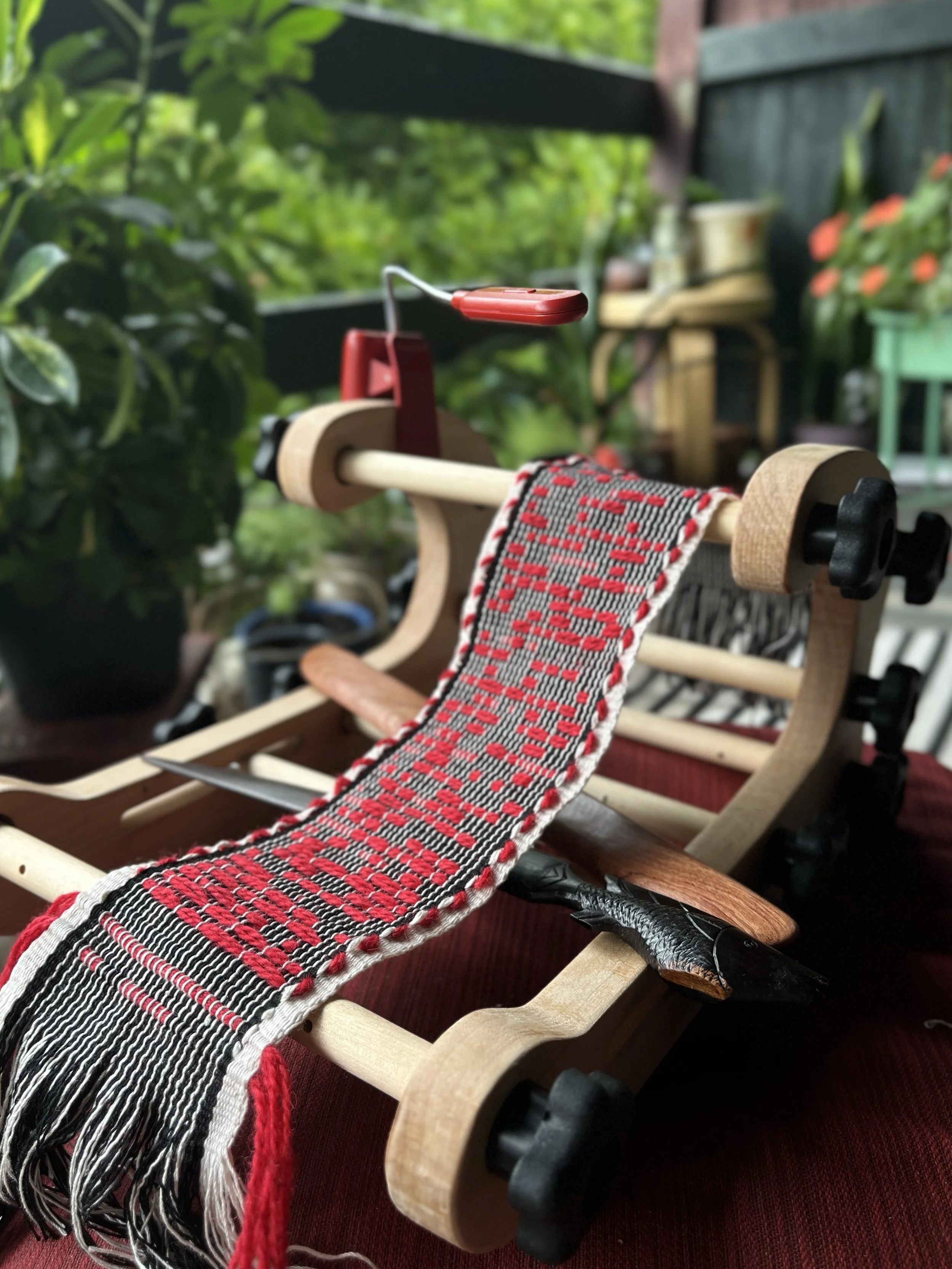
In Black & White: The Receipts (Cotton & wool, approx 4×20”)
Pictorial warp-faced weaving cut from the loom and awaiting finishing. This will be available at the First Annual Art Crawl & Auction hosted by Bald Eagle Art League in September and October 2026. More details soon.
The first piece in the collection is called The Receipts. It’s my attempt at addressing the desire to identify, name, and look honestly at what happened instead of polishing memory until it becomes more comfortable than truth.
Receipts are simply evidence. They remind us what we experienced was real, even when time begins softening the edges, and longing or shame tempt us to rewrite the story.
Weaving this piece didn't answer my questions, and it wasn't supposed to; it simply gave them somewhere to live outside my own mind.
Learning to See
At the same time, I’m also returning to painting. Years ago I painted in acrylics and sold a handful of pieces. I've been learning watercolor, which has no interest in whether I was once competent in another medium. It asks me to become a beginner again.
Naturally, that's been a gift.
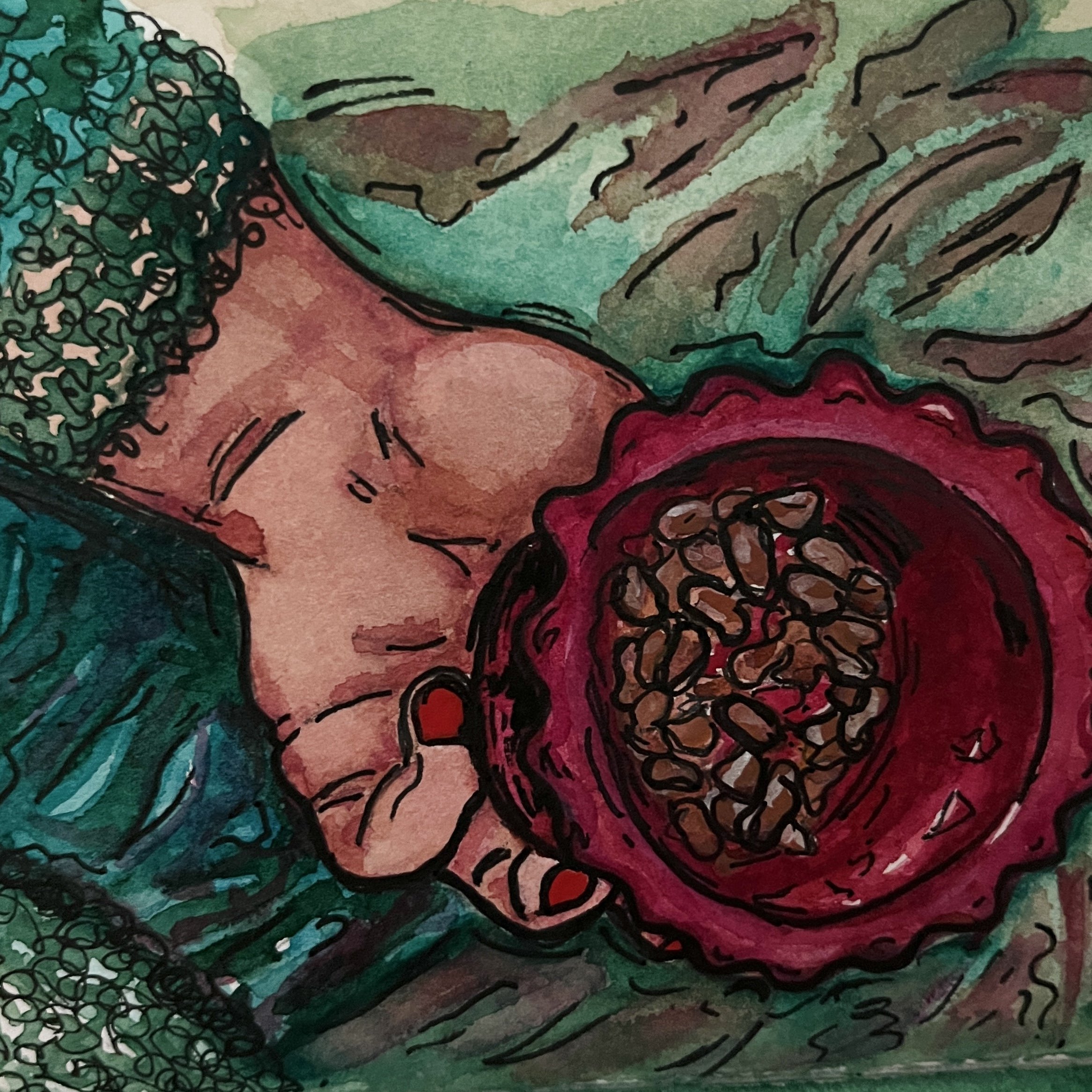
Recent watercolor journal entry. Are they peanuts, or are they rabbit turds? Turns out that depends on who is looking.
There's a line attributed to Paul Valéry: to see is to forget the name of the thing one sees. Painters understand this instinctively. The moment a tree stops being "a tree," you begin to notice the cool blue in its shadows and the warmth where the evening sun catches the bark. A white mug becomes lavender, gold, and reflected sky.
The ordinary becomes astonishingly complex through attention. Children know how to pay this kind of attention without trying. I did once, without meaning to, at a bus stop nobody used.
The Long Middle
Lately, I've had the curious feeling that the world has become very large again, like it was when I was a child. It's as though certainty has quietly stepped aside, leaving room for wonder and unanswered questions.
Maybe I’m just more willing to let go of my hold on things and watch them do what they will, understanding they were only ever going to do just that.
Our culture admires dramatic comebacks and tidy narratives of transformation. We like before-and-after photographs because they reassure us that difficult things eventually resolve.
Real life is less obliging.
Most of us spend far longer in the middle than we do at either end. Lately that's where I'm learning to sit, seeing my unanswered questions in the only way I know how. As painters do. As children do.
Jewelweed
I’m writing this during a summer rainstorm, sitting on my balcony full of greenery, flowers, and lively squirrels. I’ve come to think of this season as a kind of convalescence. It feels like an old word that suggests recovery without hurry.
Invisible work is taking place inside me, whether or not I happen to be watching the steam.
Cloud machines. That’s what I called the power plant’s cooling towers, when my young daughter asked what they were years later.
I don't know what this life chapter will ultimately make of me. I do know that as it winds down it's making something, thread by thread, color wash by color wash, sentence by sentence.
The jewelweed I touched that morning didn't burst because it was failing. It opened because it had reached its own moment, because something inside it had been quietly gathering all along, and the smallest contact was enough to send it outward.
For now, I’m content to continue convalescing. To keep weaving and moving color across white paper. To continue learning how to see.
For now, I will be a little like the riverside jewelweed, growing toward an ordinary morning.
A Few Recent Things
Lately, I’ve been thinking a lot about attention; how easily it gets flattened into utility, productivity, scrolling, documenting, answering. I’ve been trying to reclaim some quieter forms of noticing through materials, image-making, and walking slowly enough to actually see where I am.
Lately, I’ve been thinking a lot about attention; how easily it gets flattened into utility, productivity, scrolling, documenting, and answering. I’ve been reclaiming some quieter forms of noticing through materials, image-making, and walking slowly enough to actually see where I am.
These are some recent observations, experiments, studio fragments, and small moments that reminded me why living a creative life matters to me.
The Studio Is Alive
There are stacks and bolts of fabric, woven samples pinned to the board, and bits of cording, paper and thread migrating across surfaces faster than I can contain them. I’m aiming for zero waste, or as close to it as possible, which equates to a lot of material accumulation. A lot.
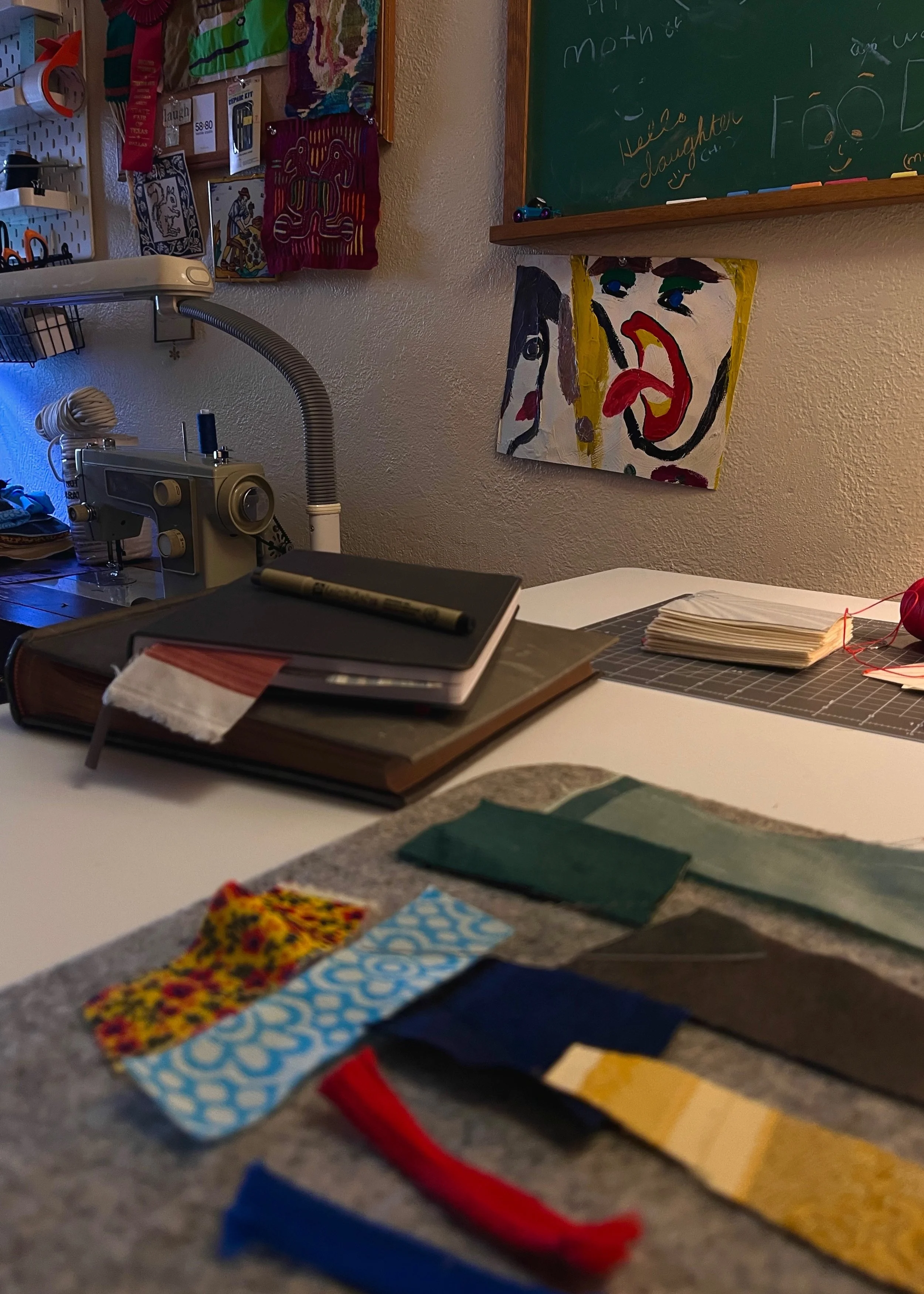
Corner of my textile studio on a recent rainy afternoon.
It already feels less like a workspace and more like an ecosystem.
Momigami + Exploration
I’ve been spending time experimenting with momigami, letting materials wrinkle, soften, collapse, and transform instead of trying to control them too tightly.
There’s freedom in allowing paper to behave like cloth and cloth to behave imperfectly.
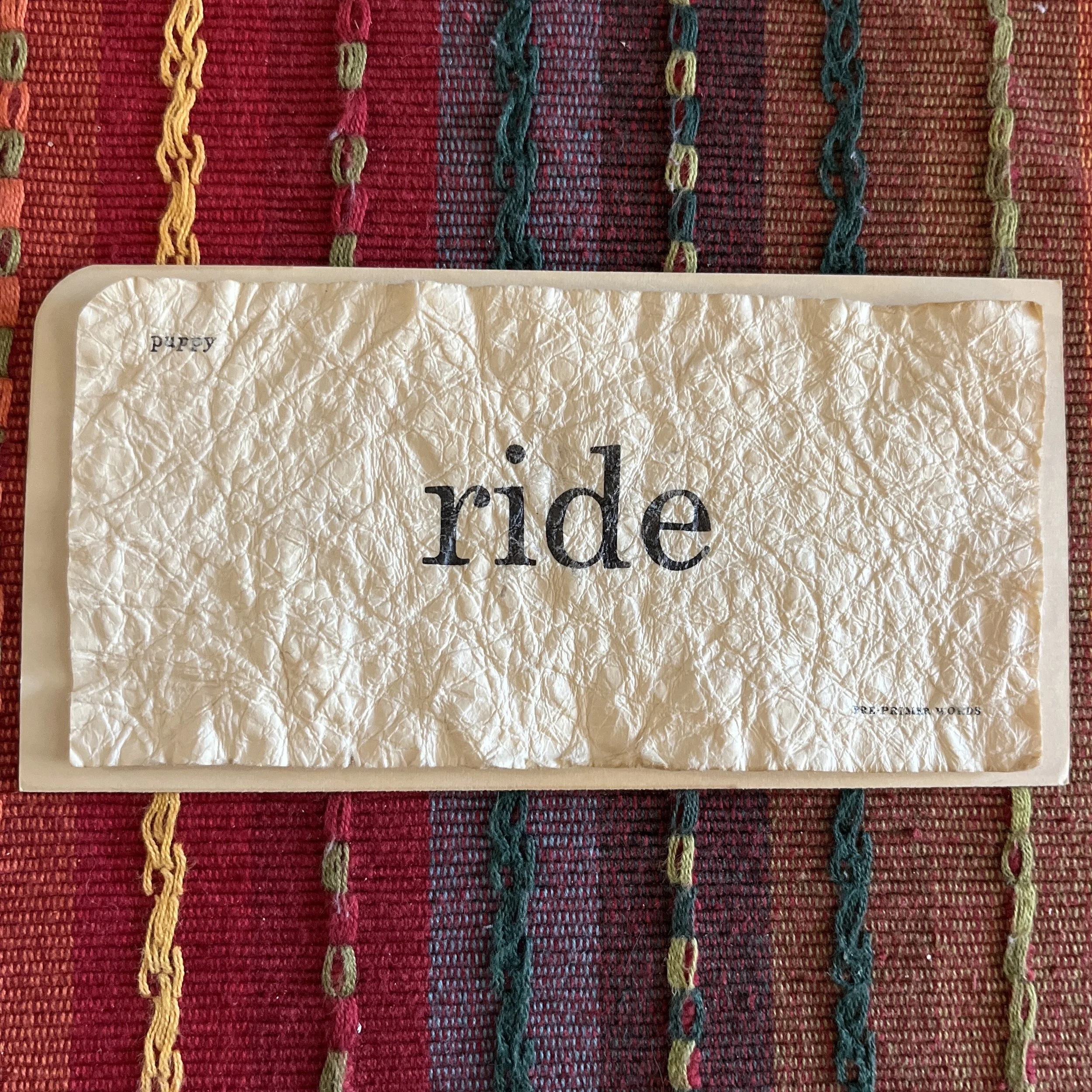
Working with vintage flash cards and konjac starch
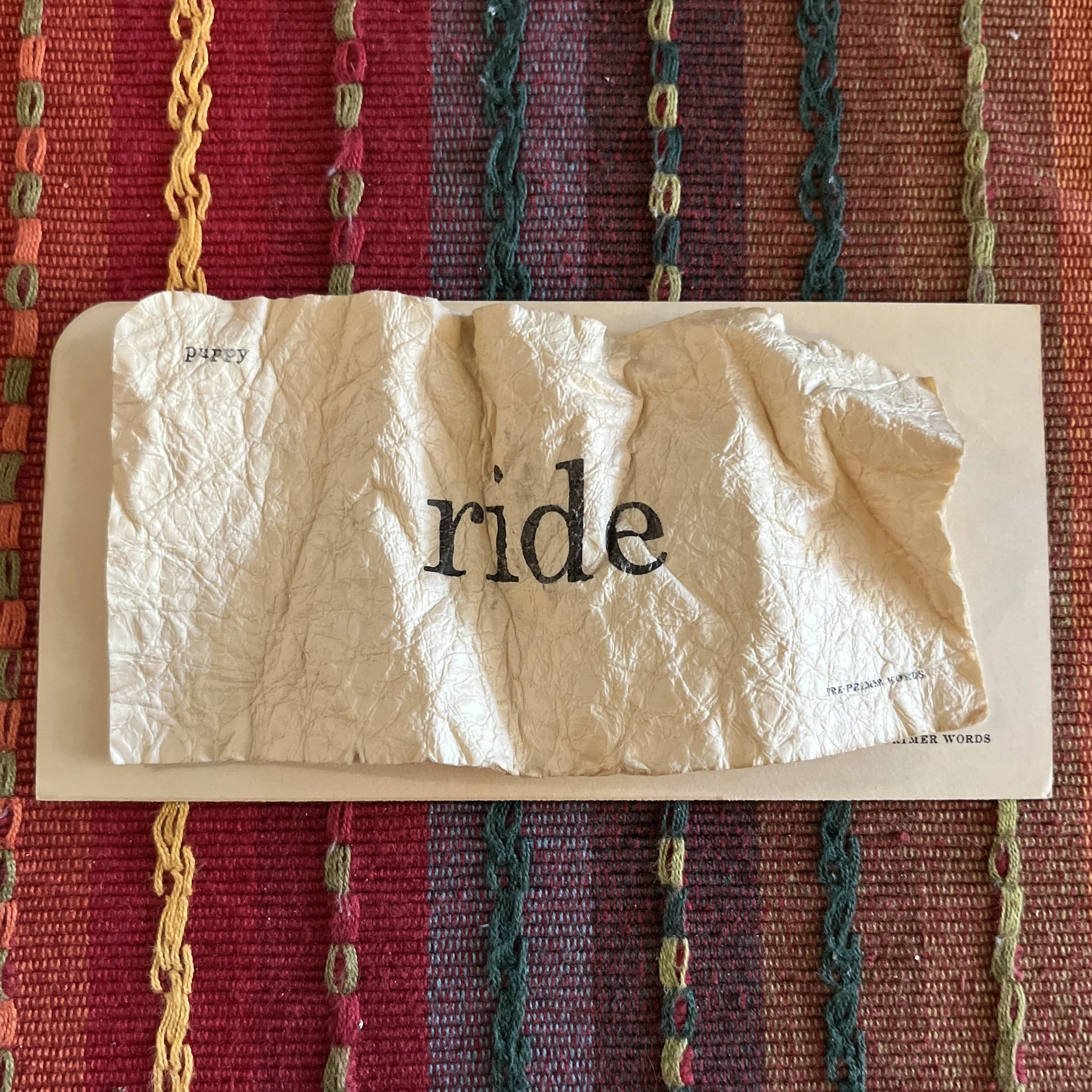
Each card takes about an hour to process
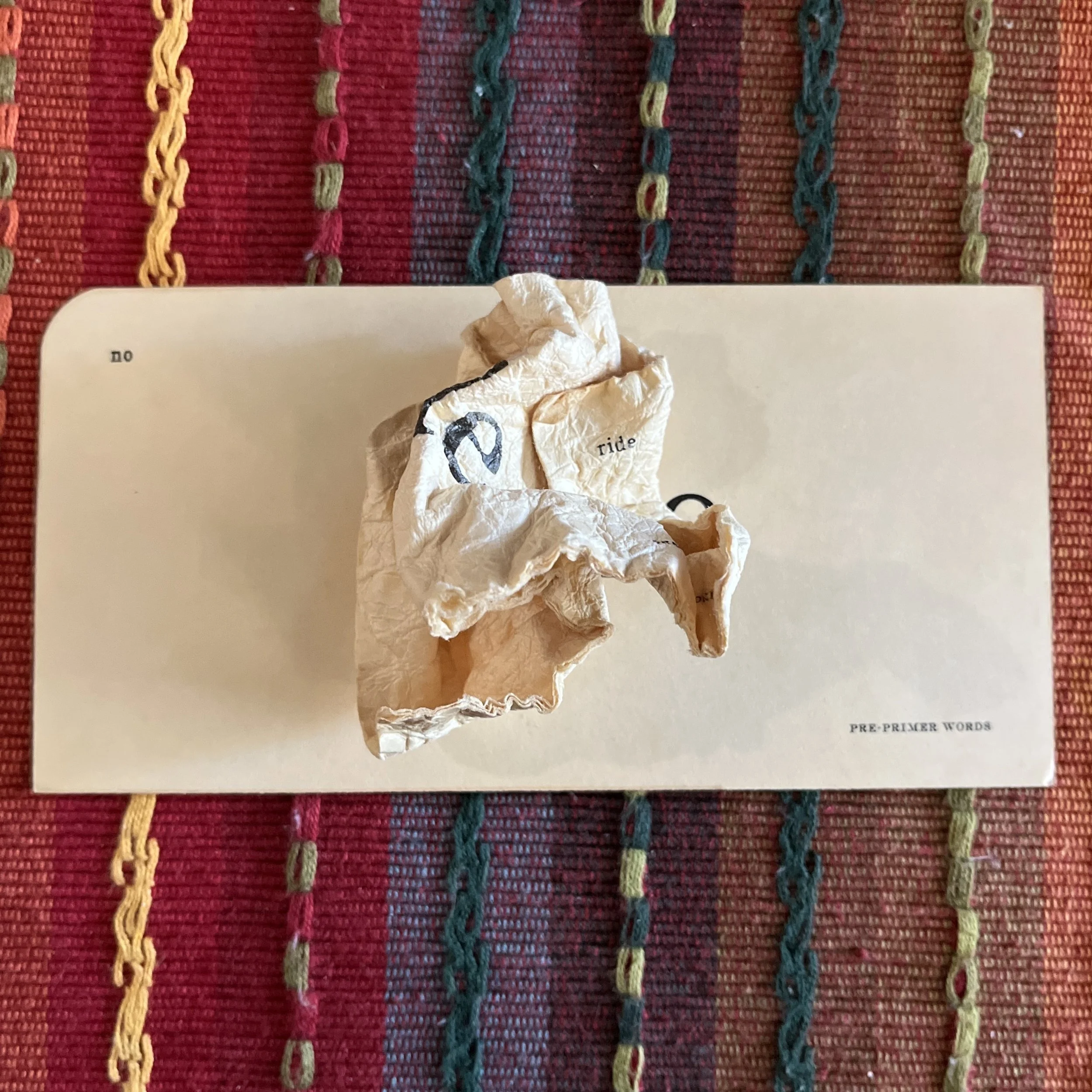
The result is a cloth-like softening of the paper fibers
Carefully using momigami technique to turn a Chagall “Woman Juggler” lithograph into cloth
Toy Camera
I recently picked up a small Chuzhao toy camera, partly as a way to reconnect with image-making outside the utility of my phone. I wanted something that encouraged observation instead of consumption, without lugging around an old film camera or my DSLR.
Unexpectedly, it’s also changed the way people interact with me.
For example, on an Easter weekend visit to Cleveland, another photographer noticed the camera and stopped to ask about it. We ended up trading portraits with each other’s cameras, something I’m fairly certain would never have happened if I’d simply raised an iPhone. The camera became less of a device and more of an invitation.
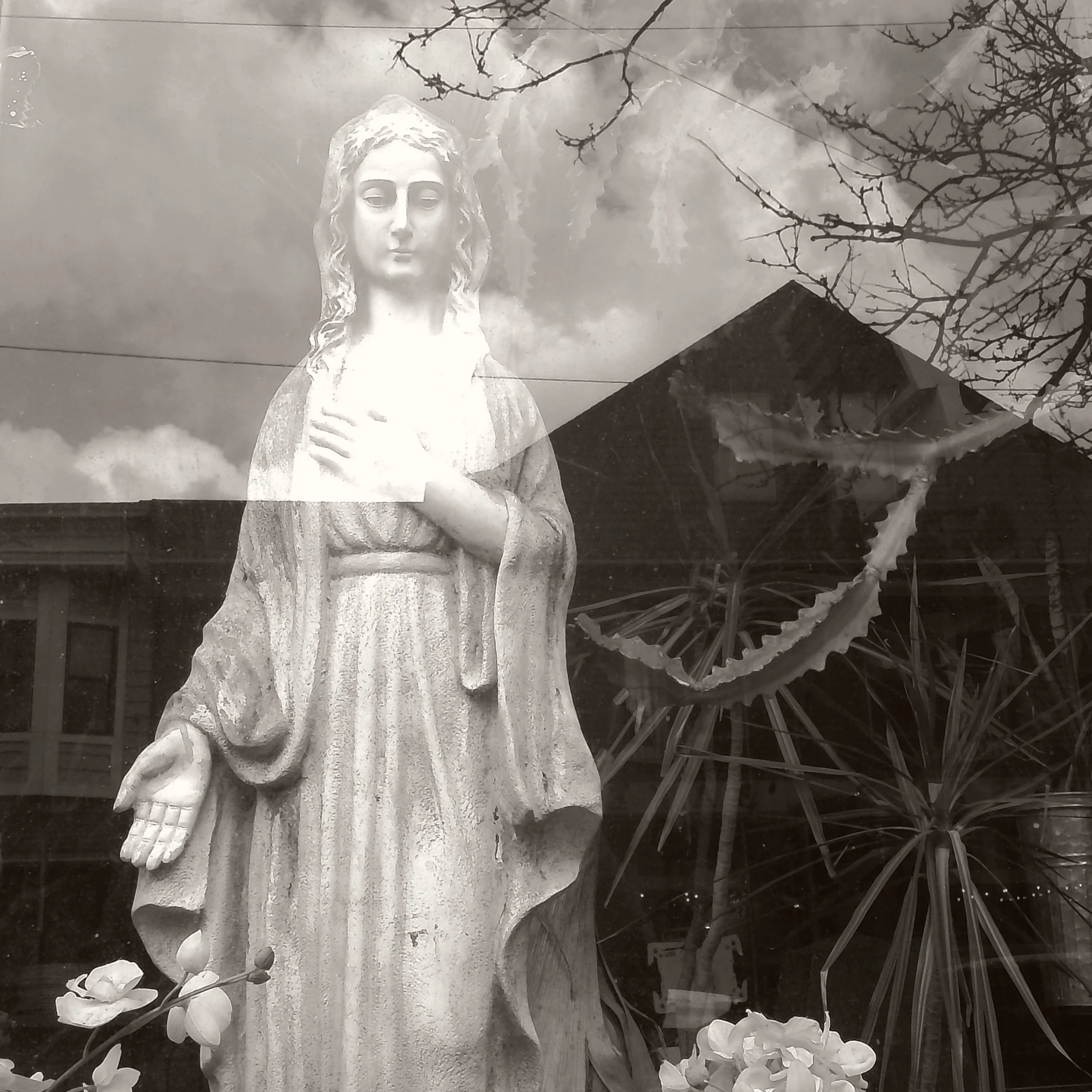
Little Italy window display. Cleveland, Ohio
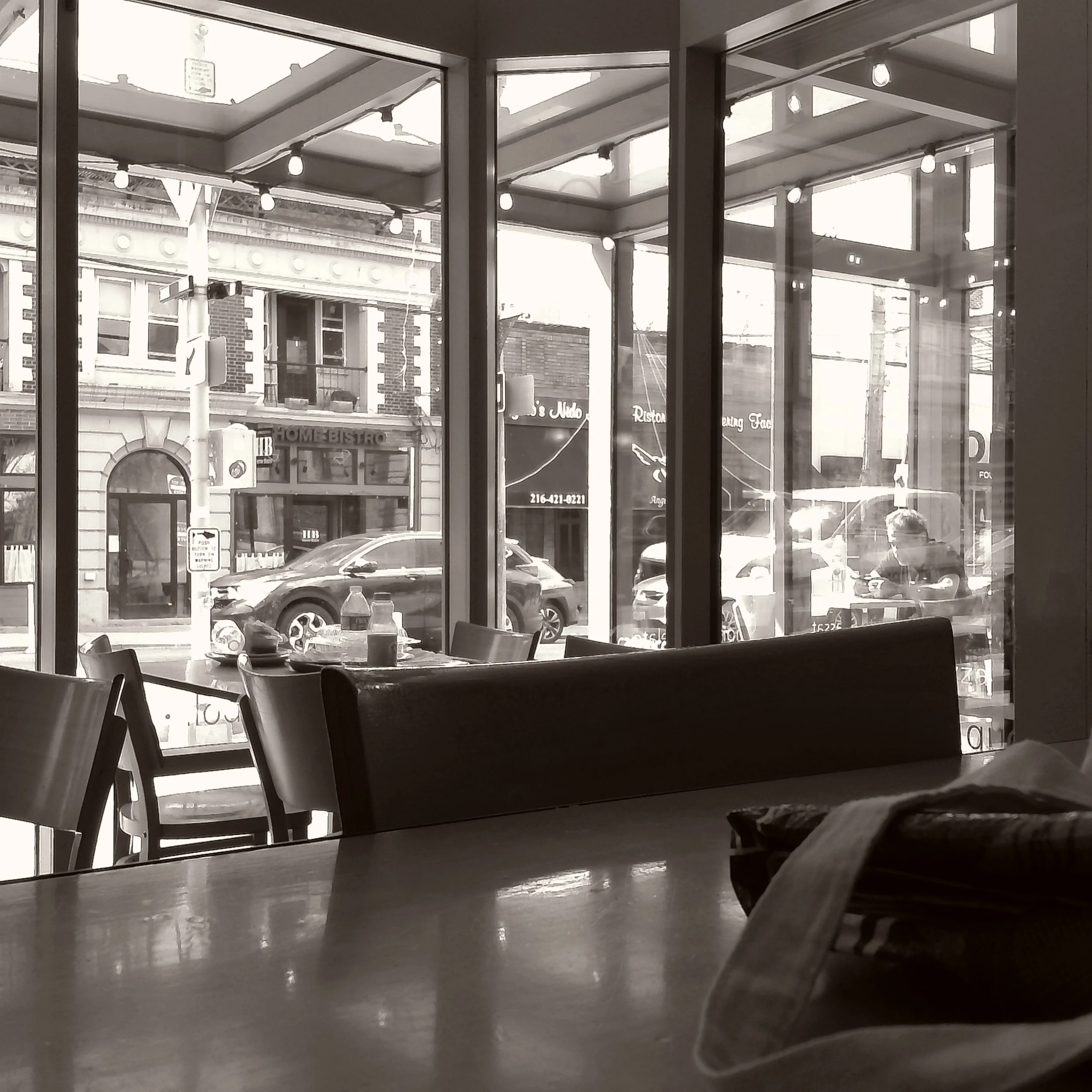
View from a cafe seat. Cleveland, Ohio

Stranger with a camera, on the lake. Cleveland, Ohio
Handmade Journal
I made a journal imperfectly on purpose.
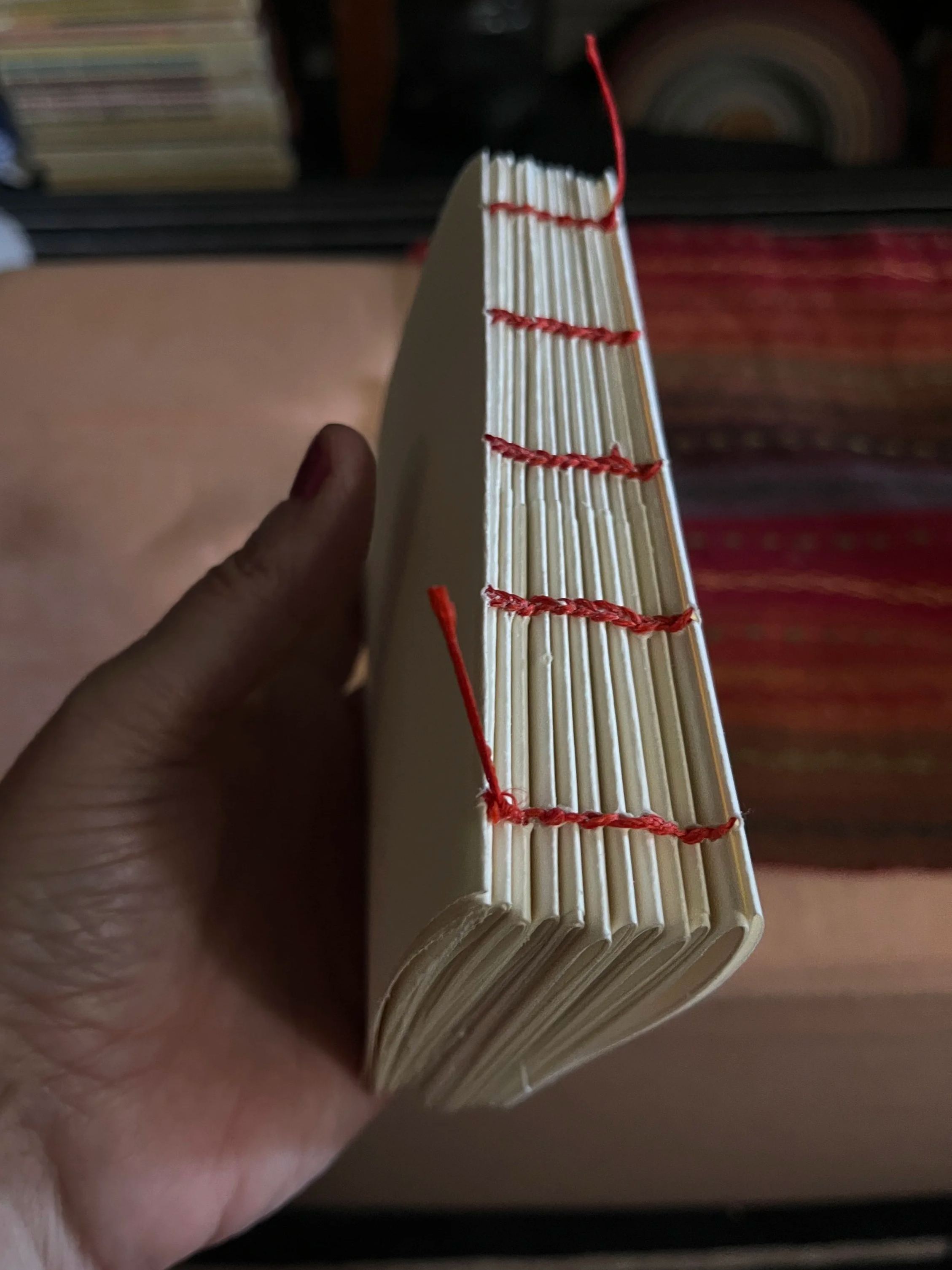
Single needle binding with waxed red thread
As someone recovering from creative perfectionism, I’ve realized pristine blank journals sometimes feel more intimidating than inspiring. This one has uneven binding and stitching, intentional mistakes, and visible decisions throughout.
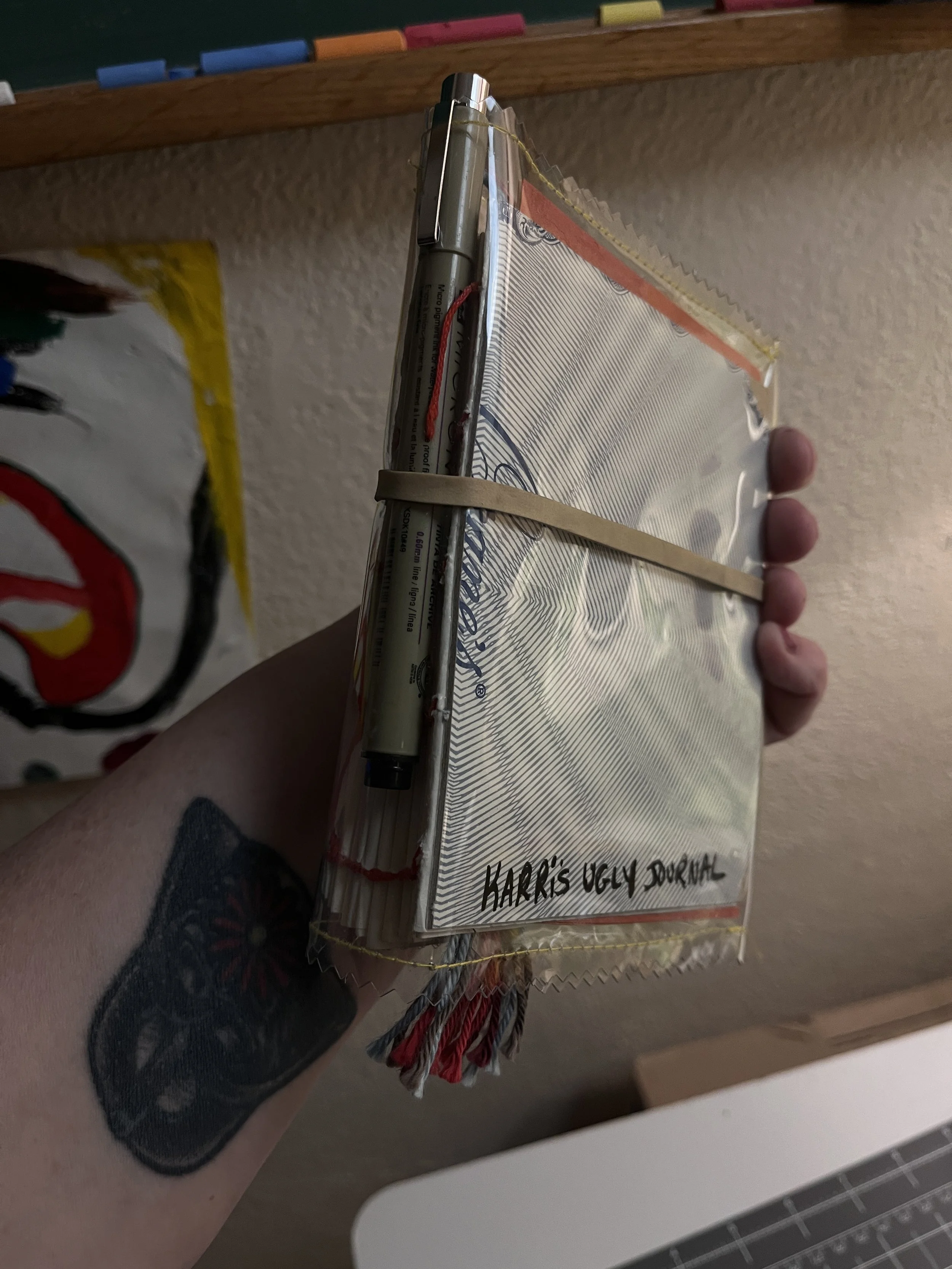
Vinyl cover for material visibility, and to hold my trusty Sakura Pigma Micron 10 in place
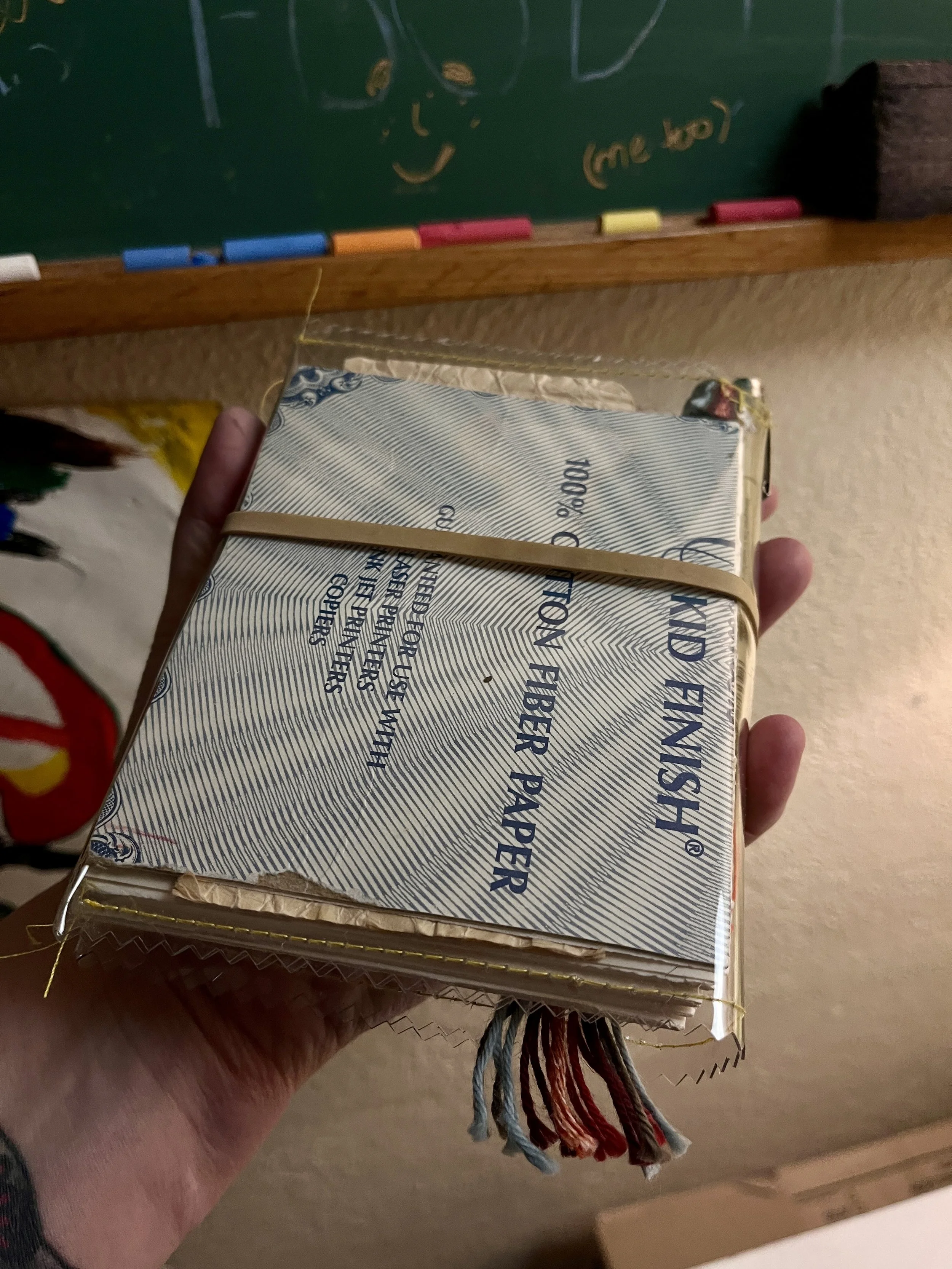
Paper box cover as book board
I made it from materials on hand, including Crane’s 100% cotton paper, the box cover as book board, and marine vinyl scraps leftover from projects for my upcoming collection.
As with so many things, the imperfection makes me love it more. And loving it makes me want to use it, which is the whole point.
Band Weaving
My first love in weaving and my favorite still, by far.
I recently wove a passementerie-style band to accompany a piece by local artist Worth Rawson, whose work I admire and enjoy. I love the conversation that can happen between materials made by different hands.
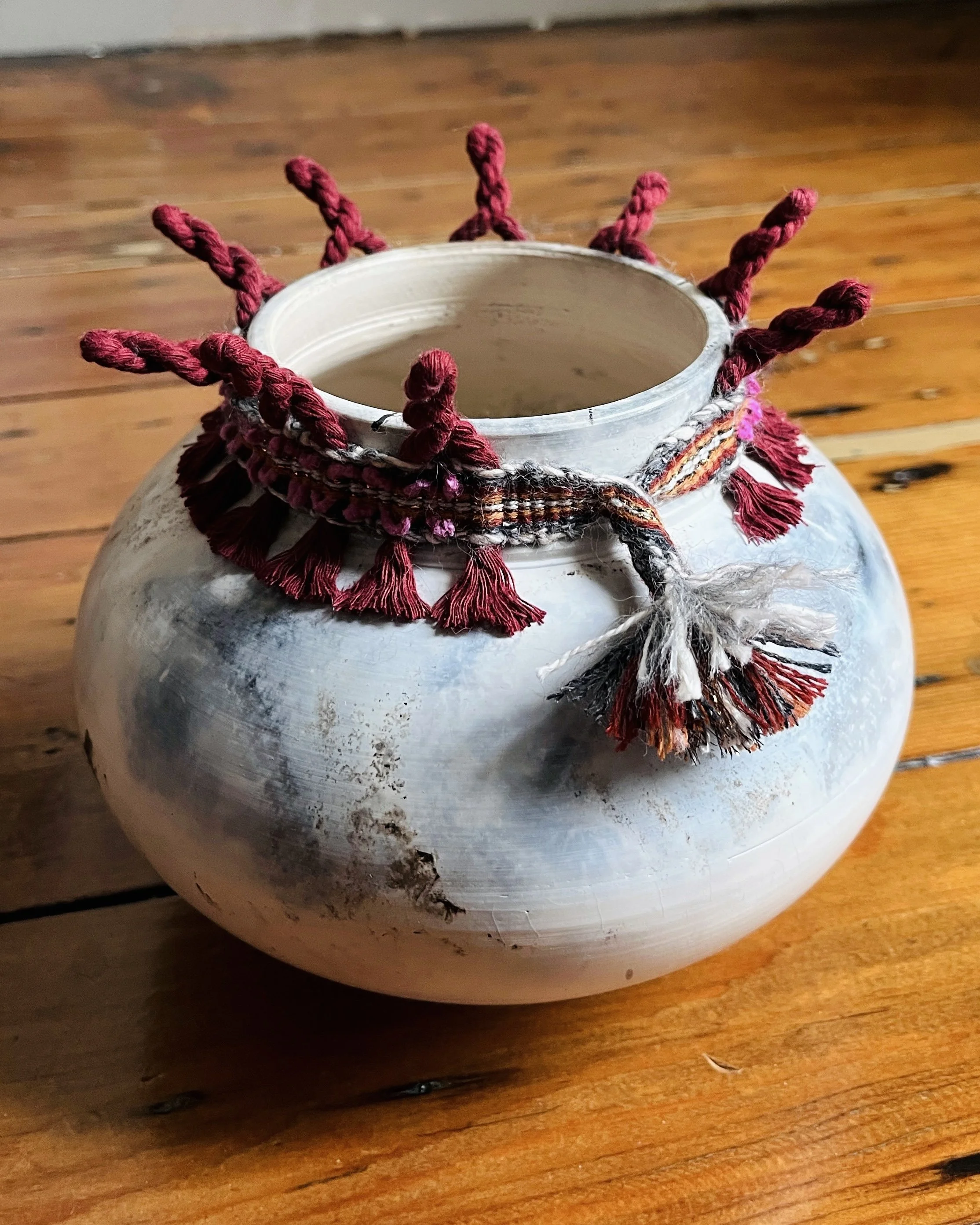
Wool, cotton, and metallic yarns in flat and tubular weave wrap the bowl like a contained eruption or crater, created to respond to the vessel’s volcanic, otherworldly quality with something playful and slightly unruly.
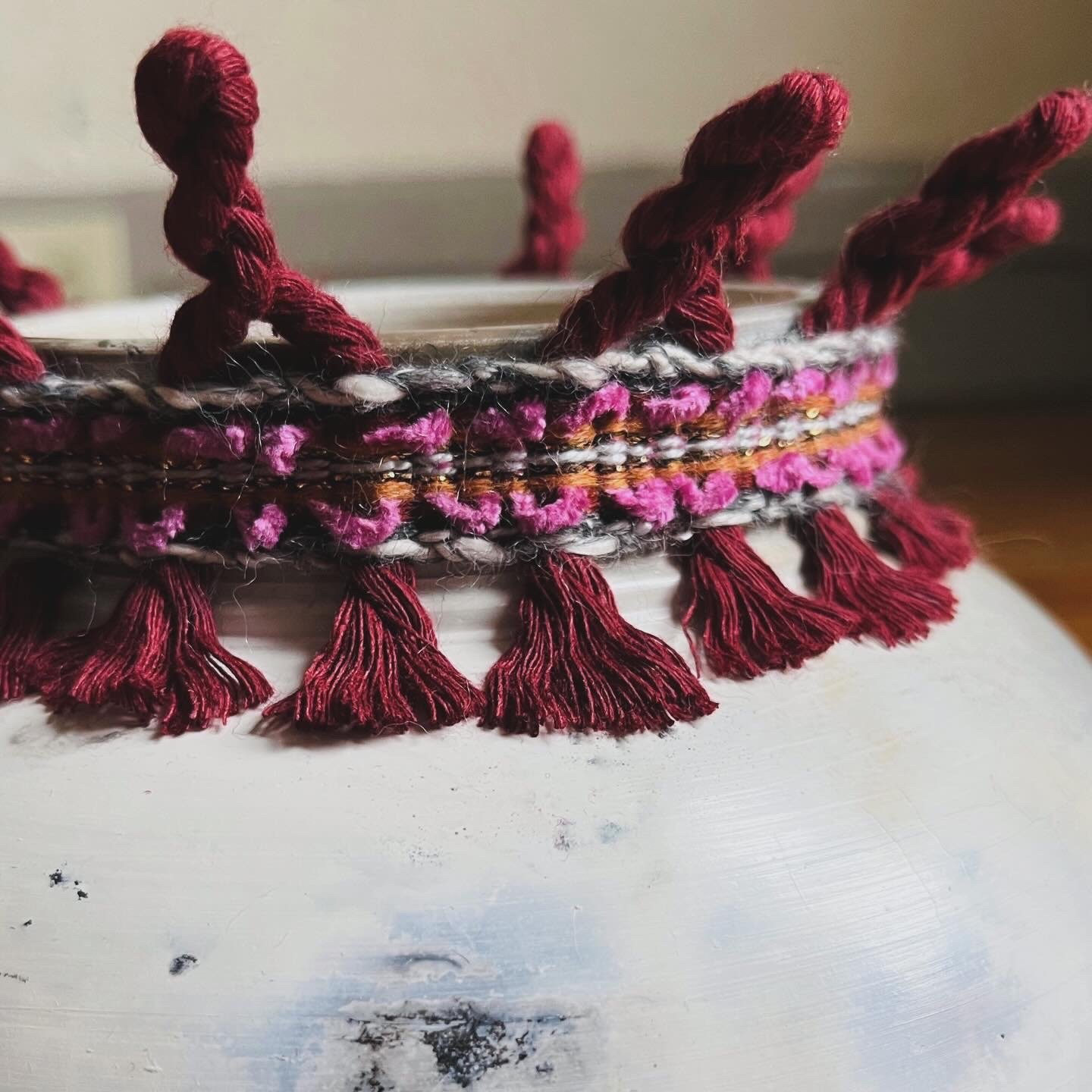
Band closeup
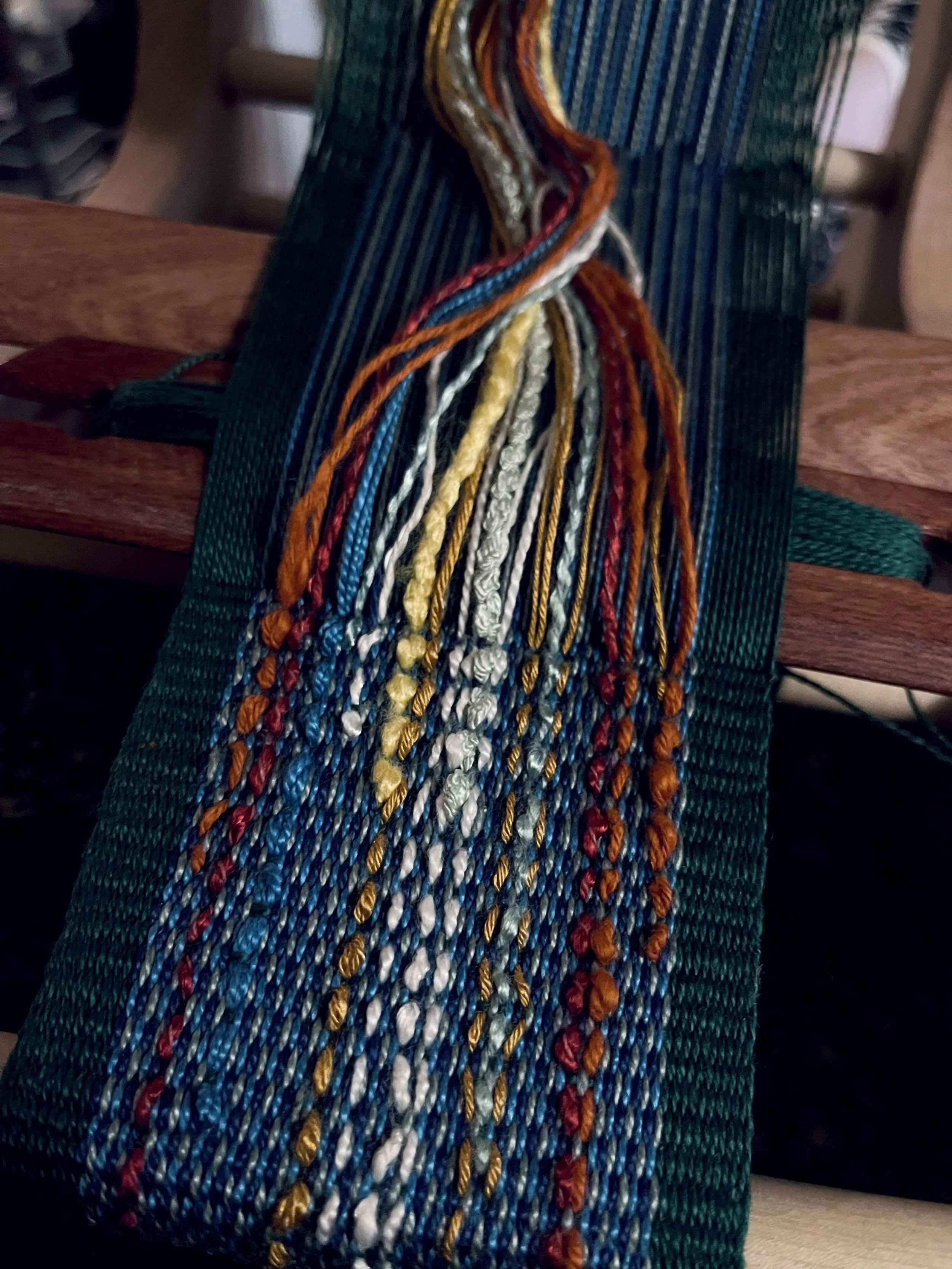
Snapshot of a wider, warp-based “tapestry” in progress using both supplementary weft and an experimental (at least for me) warp inlay techique.
Weaving in the Wild
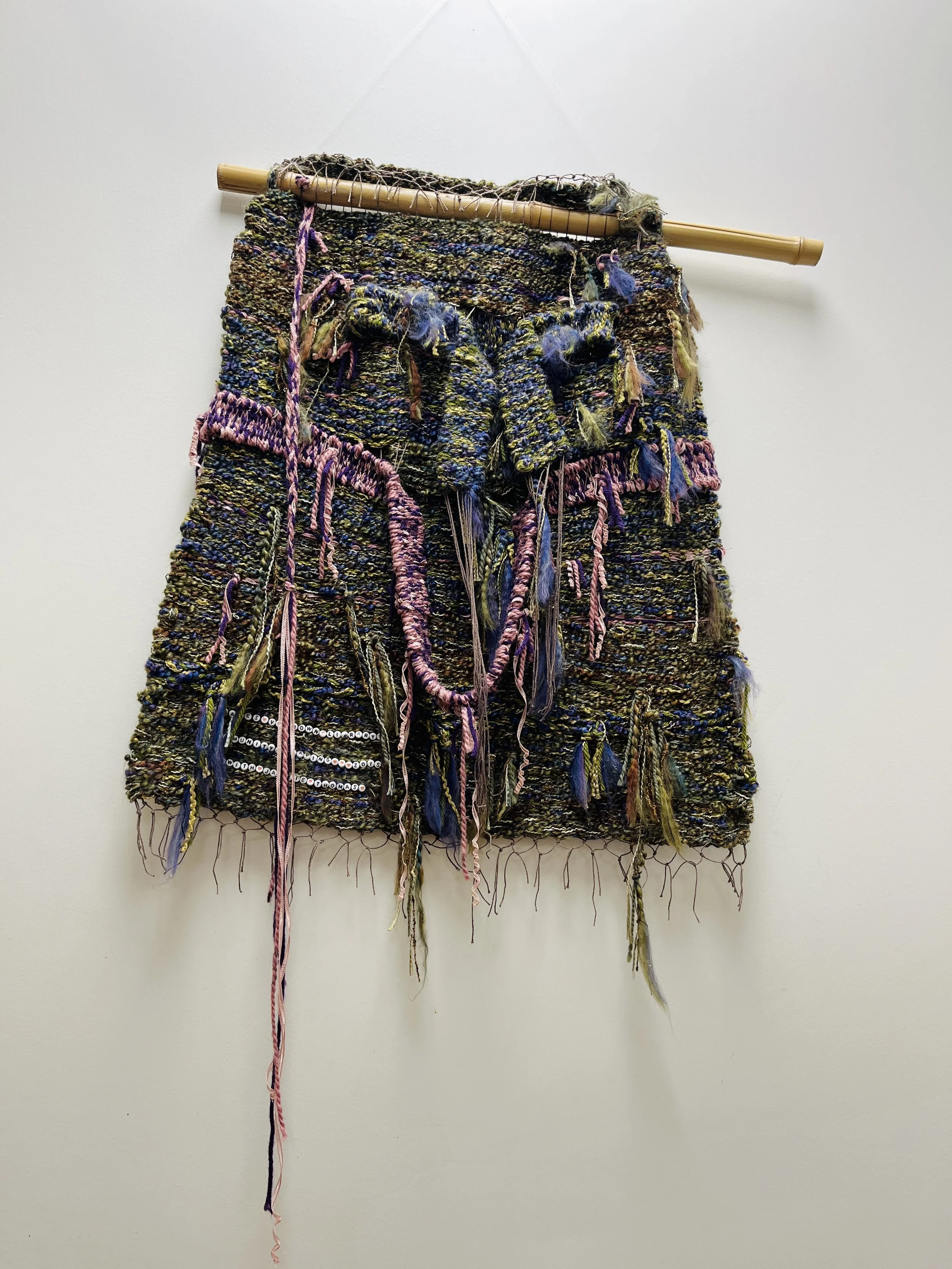
A weaving I stumbled upon at the local library.
There are several exciting projects, studio developments, and local events unfolding right now that I’ll be sharing here soon. For now, this feels like an honest snapshot of where my creative life currently is: exploratory, imperfect, material-driven, and increasingly rooted in attention.
The Expanding Language of Fiber
At some point, fiber art quietly slipped past the boundaries people tried to place around it. What was once expected to be soft, woven, domestic, functional, or even recognizable as cloth has expanded into something much harder to define.
At some point, fiber art quietly slipped past the boundaries people tried to place around it. What was once expected to be soft, woven, domestic, functional, or even recognizable as cloth has expanded into something much harder to define.
Contemporary fiber artists now work with steel mesh, silicone, monofilament, rubber tubing, magnetic tape, industrial felt, vinyl, taxidermied hide, plastic fencing, and other materials that seem to resist the category entirely.
Some pieces drape like fabric but contain no traditional fiber. Others are technically woven or stitched, yet resemble architecture, skin, erosion, armor, or biological specimens more than anything we instinctively think of as textile. Somehow, we still recognize them as part of the same language.
I keep returning to the question: what actually makes something fiber art?
Is it the material itself? The process? The structure? The relationship to the body? The visible labor? Or is it something more instinctive than that, something we humans recognize before we even have words for it?
The more contemporary fiber expands, the less stable the answers become.
For a long time, the definition seemed relatively straightforward. Textiles were woven, stitched, felted, braided, and knotted. Fiber meant thread and cloth, pliability and softness. But contemporary artists seem increasingly uninterested in preserving those clean boundaries. I think that resistance is part of what makes the field feel so alive right now.
Leather complicates the conversation almost immediately.
It’s organic, flexible, wearable, sewn, folded, stretched, deeply tied to textile traditions, and historically inseparable from garment making. Yet technically, it isn’t fiber. It’s skin. So where does it belong?
And once leather enters the conversation, the line starts dissolving quickly.
What about woven copper mesh that folds like cloth? Chainmail that drapes over the body like fabric? Silicone stitched together until it resembles flesh more than textile? Animal hide sewn into sculptural work? Synthetic turf woven into tapestry structures?
So many questions.
At what point does material stop mattering? Or maybe the better question is: did it ever matter as much as we thought it did?
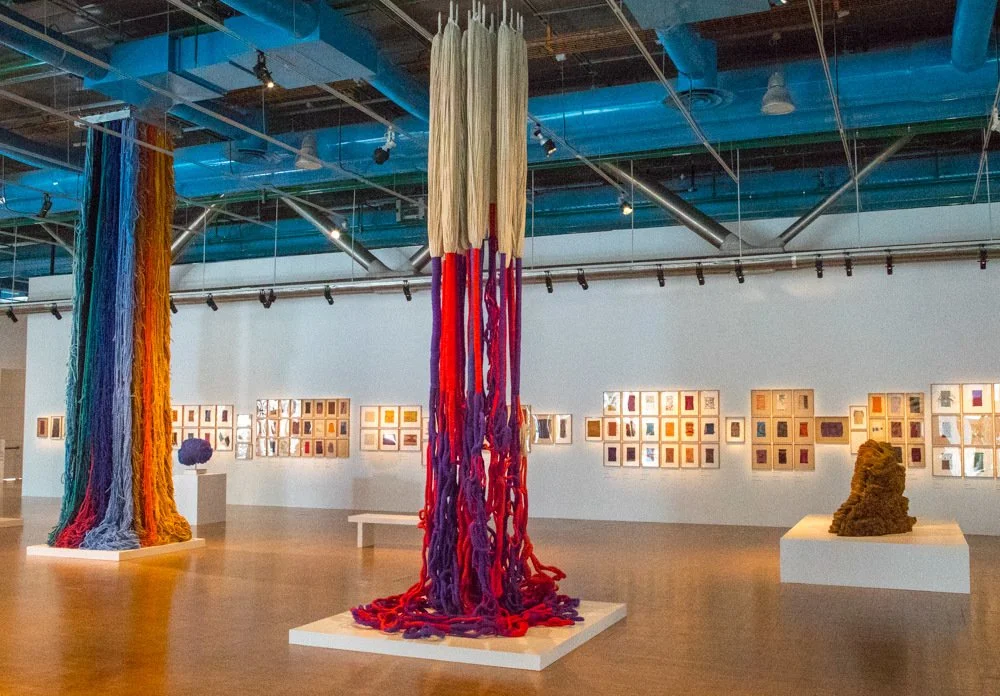
From the collected works of contemporary fiber artist Sheila Hicks
Artist Sheila Hicks often speaks about fiber as language rather than category, and I think that framing opens something important. Hicks has worked with linen and wool, but also industrial cordage, found materials, synthetic elements, and objects that move freely between sculpture, installation, architecture, and textile.
Language evolves the moment people start using it differently.
It absorbs slang, disruption, misuse, regionalism, and internet shorthand. Words once considered “incorrect” eventually become accepted through repetition and cultural adoption. A phrase like “six seven” embeds itself into collective vocabulary not because anyone formally approved it, but because enough people understood and agreed upon the rhythm or meaning behind it.
Fiber feels similar to me.
Once enough artists begin weaving with wire, stitching silicone, knotting industrial plastics, or constructing textile forms from materials historically excluded from the category, the language itself begins stretching to accommodate them. Not because museums allow it, but because the work insists upon itself.
Interestingly, humans still respond to these works as textile.
A woven steel structure feels fundamentally different from a sheet of metal. A stitched silicone form feels strangely bodily in a way molded plastic doesn’t. Repetition, interlacing, drape, compression, tension; these things communicate something ancient to us regardless of whether the material came from sheep, petroleum, roadwork, or a hardware store clearance bin.
Maybe fiber art has less to do with purity of material and more to do with relationship.
One thing passing through another. Another structure holding tension. A surface built slowly through accumulation and touch.
Taxidermy creates another fascinating edge case.
Most people would classify taxidermy as preservation or sculpture rather than fiber art, but historically the separation becomes harder to defend the longer you sit with it. Hide sewing, stitched pelts, fur garments, sinew thread, woven hair, and animal-based textile traditions have existed for thousands of years.
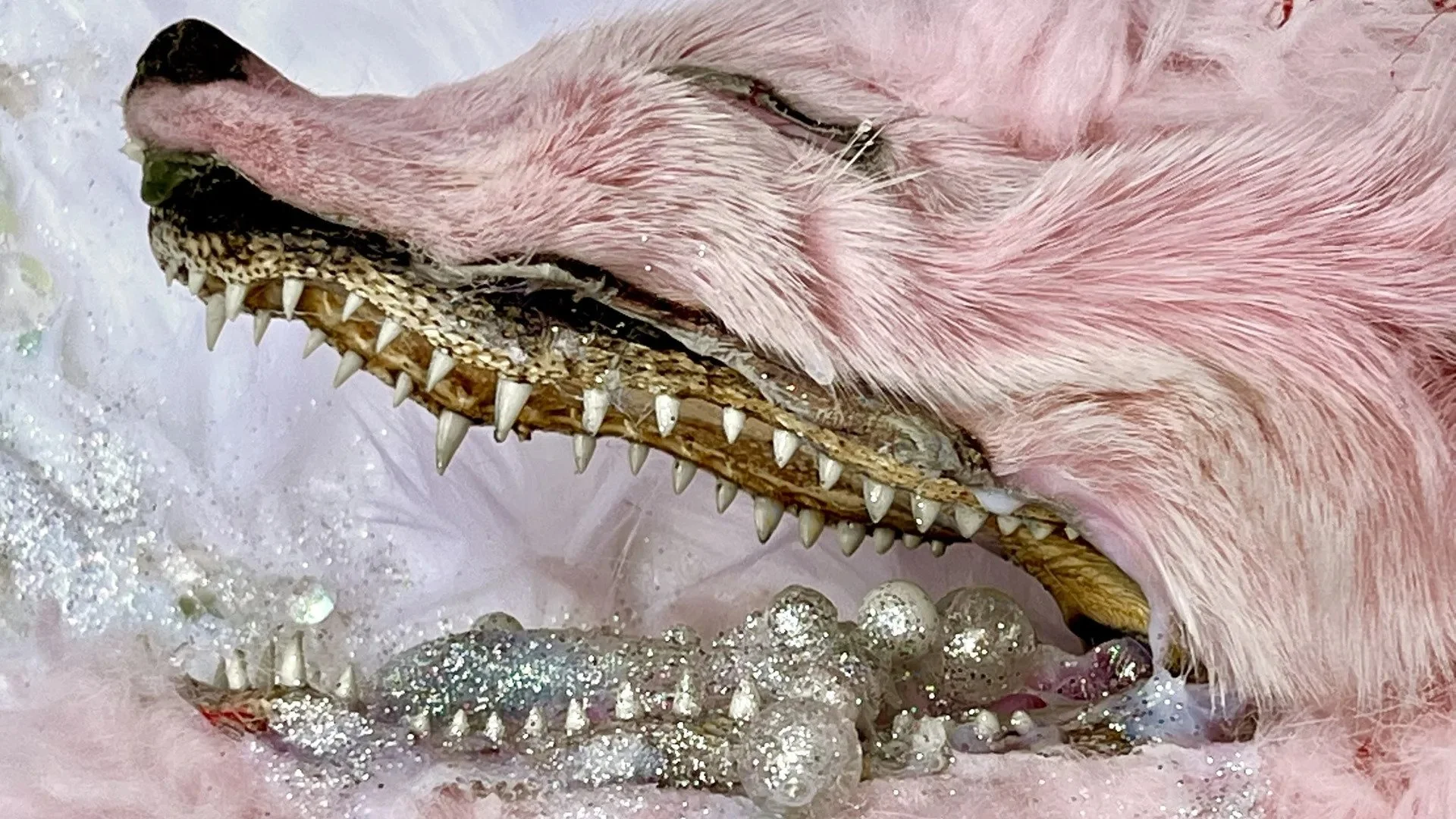
Kelly Boehmer, Drool (detail), 2022. 46cm x 61cm (18″ x 24″). Hand stitch. Taxidermy, acrylic, faux fur, real fur, beads, glitter, organza, yarn, canvas. Image from textileartist.org
Contemporary artists working with hide, bone, fur, or preserved animal material often unsettle viewers precisely because they collapse distinctions between cloth and body, softness and mortality, textile and flesh. Artist Kelly Boehmer works in atypical fiber media to convey themes of anxiety, growth, and death.
The discomfort becomes part of the work itself. I think that discomfort matters.
Fiber art has long been dismissed as safe, decorative, domestic, feminine, soft. But contemporary textile work increasingly refuses those expectations. It can feel industrial, uncanny, confrontational, mournful, biological, even grotesque. It can behave more like architecture or skin than cloth.
Still, the language remains recognizable somehow, maybe because textile processes leave evidence behind in a way few other mediums do. Textiles usually reveal how they came into being. You can trace the movement. The labor remains visible in a way not often readily apparent in many art forms.
The body remains visible.
Maybe that’s why humans continue responding so instinctively to textile structures, even highly experimental ones. We recognize tension, repair, compression, fragility. We recognize accumulation. We recognize touch.
Museums and galleries have begun embracing this expanded definition of fiber more openly, exhibiting works that move fluidly between sculpture, installation, textile, and material experiment. Contemporary fiber shows increasingly include industrial materials, synthetic forms, digital fabrication, found debris, biologically ambiguous structures, and work that would have been excluded from the category entirely a few decades ago.
I’m less interested in institutional validation than I am in the questions these works continue to raise. What makes something textile? Can a material behave like cloth without technically being cloth? If something is woven, does that matter more than what it’s woven from?
And why do we remain so emotionally responsive to interlaced structures, even when the materials themselves feel cold, synthetic, or unfamiliar?
I don’t think there are clean answers. Honestly, I hope there never are, or if so that we continue chasing the answers with further questioning. Something about the uncertainty feels deeply human to me, much like fiber art at its best: adaptive, relational, impossible to pin fully into place.
The Habit of Creating
Religion was not kind to me as a child. I say that plainly, without drama, because the details matter less than the outcome. What stayed with me was not belief, but a sense of wonder around the human instincts to mark time and make meaning, even within imperfect or painful structures.
Religion was not kind to me as a child.
I say that plainly, without drama, because the details matter less than the outcome. What stayed with me was not belief, but a sense of wonder around the human instincts to mark time and make meaning, even within imperfect or painful structures.
Despite the harm, I found beauty in rituals, ceremony, shared meals and seasonal rhythms. I found solace in the quiet comfort of doing familiar things like lighting candles, observing holidays, singing songs, and making objects with care. These small, repeated acts offered a sense of grounding amid chaos. They created order where none was guaranteed.
I didn’t have language for it then, but I was already learning something essential: meaning does not require a reason, or belief. Meaning requires attention.
Creation as a Way of Being
That early understanding returns to me now when I think about creativity.
In The Creative Act, Rick Rubin describes the creator not as someone who produces, but as someone who receives. A vessel, or a conduit. Someone attentive enough to notice what is already present and willing enough to let it move through them into form. Rubin’s framing articulates a truth that resonates deeply with my lived experience. For me, creating has never felt like forcing or coercing something into existence; it feels more like participation, like giving form to something that already exists.
When creation is present in my life, I feel more awake and responsive to the world around me. In its absence, what I miss is not productivity or output, but the sensation of being in conversation with life itself.
Creation, for me, is one of the most reliable ways to feel alive.
Stagnation Is Not Failure
Most of us don’t stop creating because we stop caring. We stop because life intervenes. Work might expand beyond its borders. Sometimes bodies need healing. Routines shift, energy thins, and seasons of transition narrow our focus.
I’ve lived through long stretches where my tools were nearby but untouched. The desire to make still existed, albeit dulled by exhaustion, injury, or the work of rebuilding a life. During those times, what disappeared was not identity, ability, or desire, but connection.
Stagnation is not failure; it’s disconnection. And reconnection rarely happens through force.
Why Habit Matters
This is where habit becomes essential, not as discipline or productivity but as care.
In Atomic Habits, James Clear writes about how meaningful change is rarely the result of dramatic action. Instead, it grows from small, repeated behaviors that make it easier to return to what matters. Habit, in this sense, is not about motivation but design.
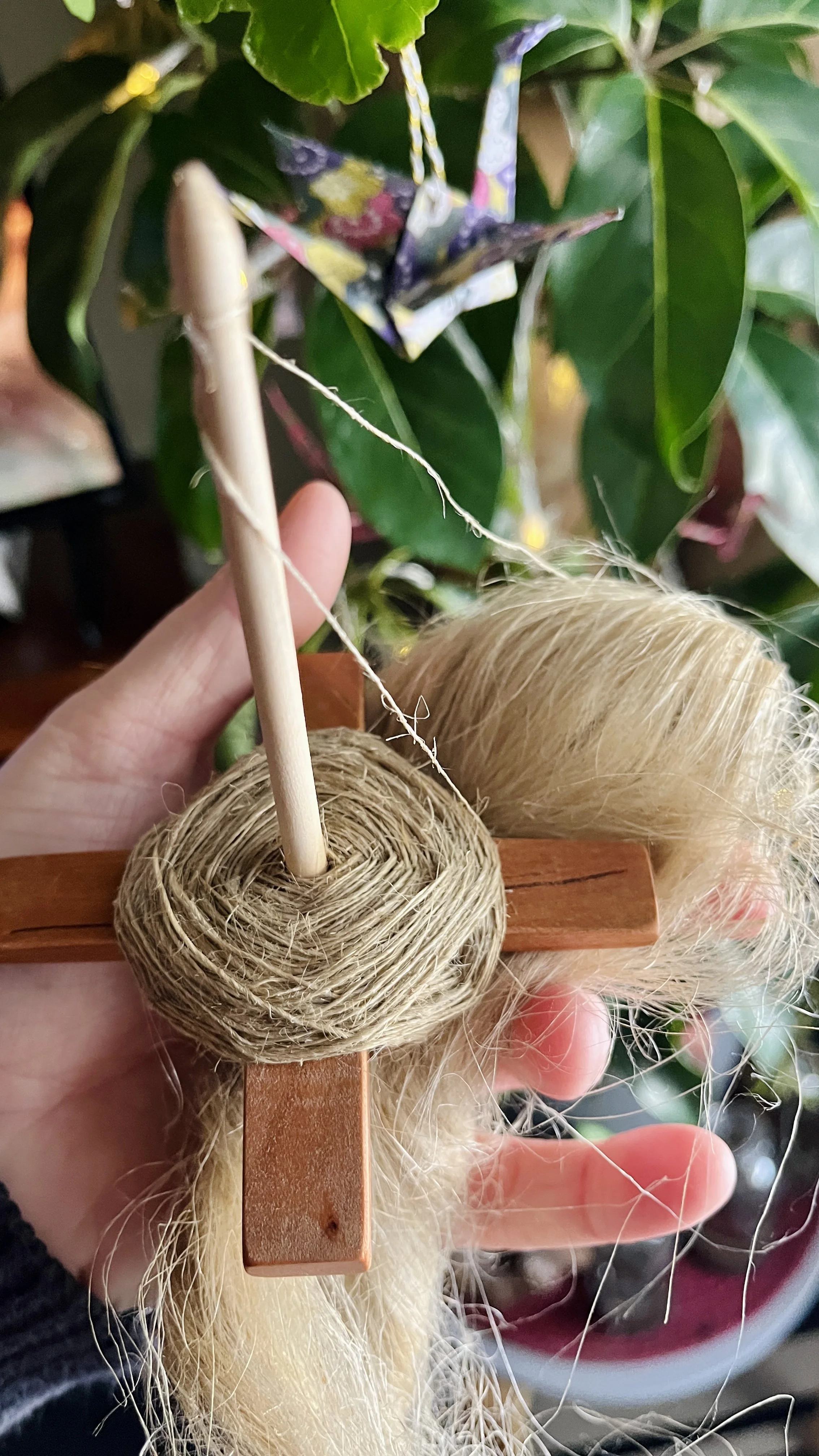
In an example of habit stacking or bundling, I placed a small Turkish drop spindle beside my couch near my favorite window. Now, instead of doom scrolling on my phone over morning coffee, I listen to audiobooks while spinning early 20th century Austrian dowry flax into linen yarn. Curious? Check out Berta’s Flachs
When I think about the habit of creating, I think less about what I produce and more about what I protect; habit keeps the channel open. Habit reduces friction and makes space for the creative act.
Stephen King tells us the muse isn’t susceptible to creative fluttering. “Your job is to make sure the muse knows where you're going to be every day from nine 'til noon. or seven 'til three. If he does know, I assure you that sooner or later he'll start showing up.”
Here are the principles that feel most relevant to the habit of creative life right now:
Environment matters more than willpower.
I recently set up my studio in my tiny apartment. Visible tools, a cleared surface, a space that quietly signals welcome—these are not simply aesthetic decisions; they make returning easier.Small acts are sufficient.
Touching the materials counts. Sitting with the tools counts. Five minutes of attention is often enough to reopen the channel.Identity precedes outcome.
The goal is not to finish or perform, but to reinforce the truth of who you are becoming. Each small act becomes a bid for participation.Incremental change compounds.
One moment of attention changes very little. Repeated moments change how we inhabit our lives.
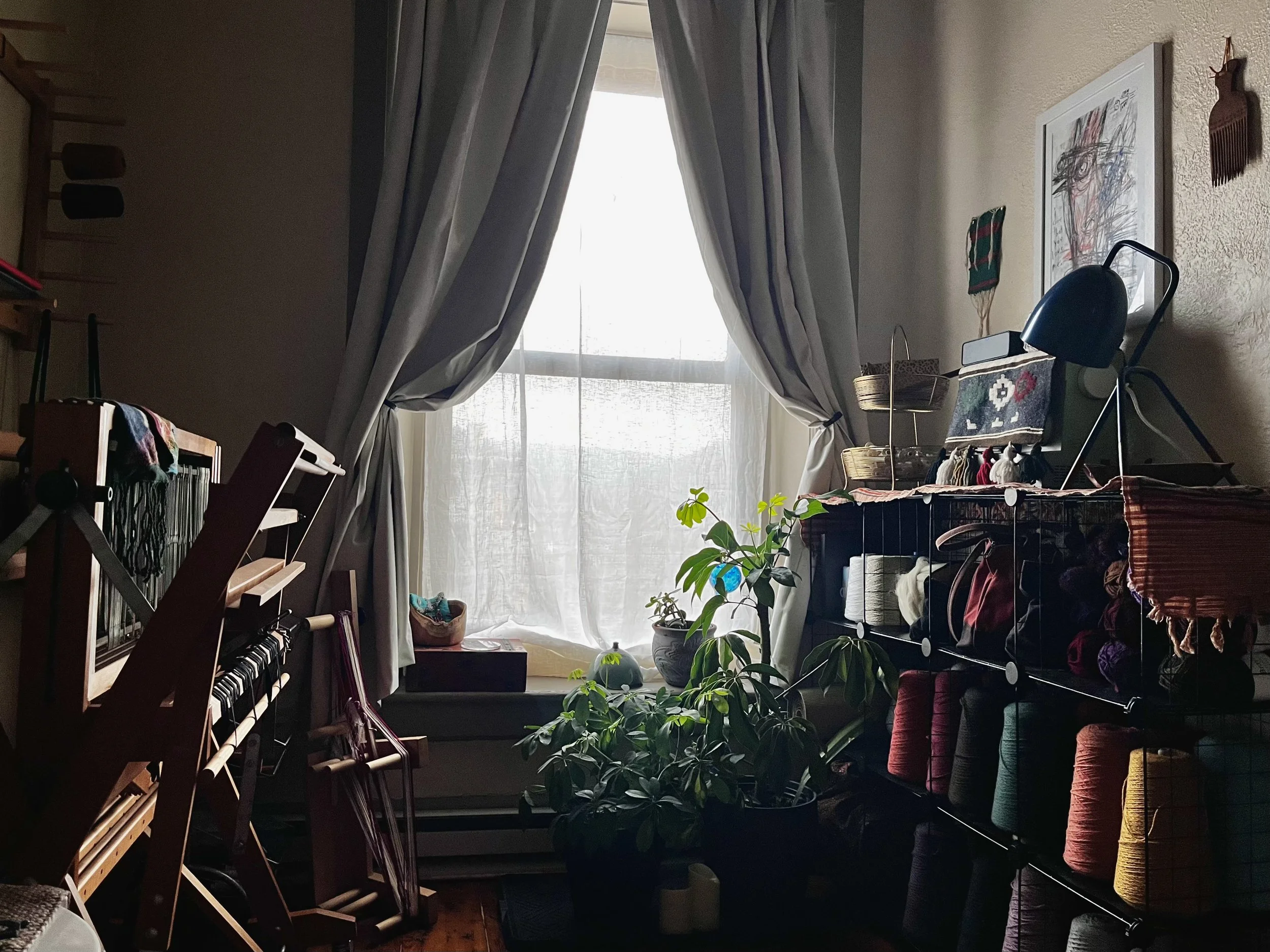
All 58 x 80 inches of my first tiny studio setup in Williamsport. Sunlight spills through the third-floor window, glinting off the loom that waits folded beside it. A downtown main street sounds from below, while the river beyond gives way to the mountains. The view alone makes this little corner feel like an artist’s loft, though the space itself is closer to a well-organized cupboard.
Habit does not manufacture joy or make us the creative vessels we already are. It simply keeps the door unlocked and tells your muse when and where to find you.
The Importance of Influence
None of us returns to creation alone.
After a major period of upheaval and transition in my life, I recently found myself feeling slightly more rooted, tentatively established, and wholly disconnected from my creative self. It took an insistent new artist friend in my adopted community to help me recognize my rut and urge me back into the act of making. He shared how one of his friends, another artist, has helped him reconnect during challenging times. We need these reminders sometimes, that we belong to a greater community, whether or not we’re feeling it.
Creators reach for one another constantly, across disciplines and distances. Sometimes that reaching takes the form of a book, a tool, or a sentence that stays with you longer than expected.
Sometimes it’s as simple and grounding as an invitation (repeatedly, for the introverts) when you are still finding your footing. These moments and the calls to “join us” matter because they hold both memory and space for us; they remind us of who we are and where we belong when we have temporarily lost contact with that knowledge.
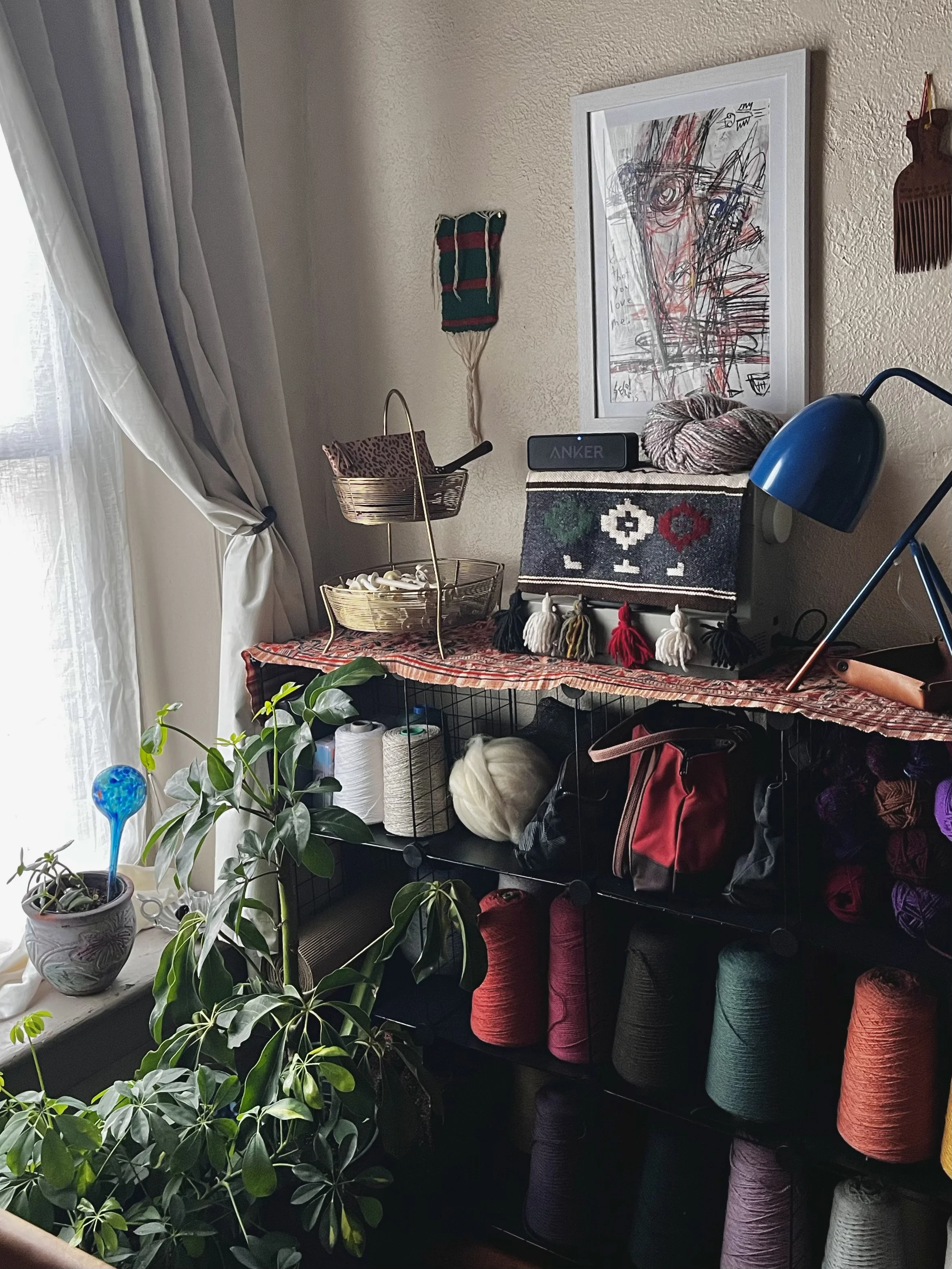
Rows of colorful wool yarns, thriving greenery, favorite tools, and my trusty Anker speaker make for an inviting space to reconnect with the creative habit. Framed art by Matt Sesow
Preparation Is Participation
I’ve recently made some small items, mostly to reacquaint myself: knitted mittens for the first snowfall, a handful of woven squares. But right now my creative life mostly looks like preparation: a small, intentional space with tools and materials within reach, arranged not for productivity but for invitation.
This preparation is not a delay. It is part of the process, as is the mental work of imagining a woven textile series, or working out the lift plan for a new weaving pattern on paper or, you know, in your head at three o’clock in the morning.
Designing a space that welcomes creativity is an act of trust. It says: I am making room. I am available. I am open to the process returning in its own time.
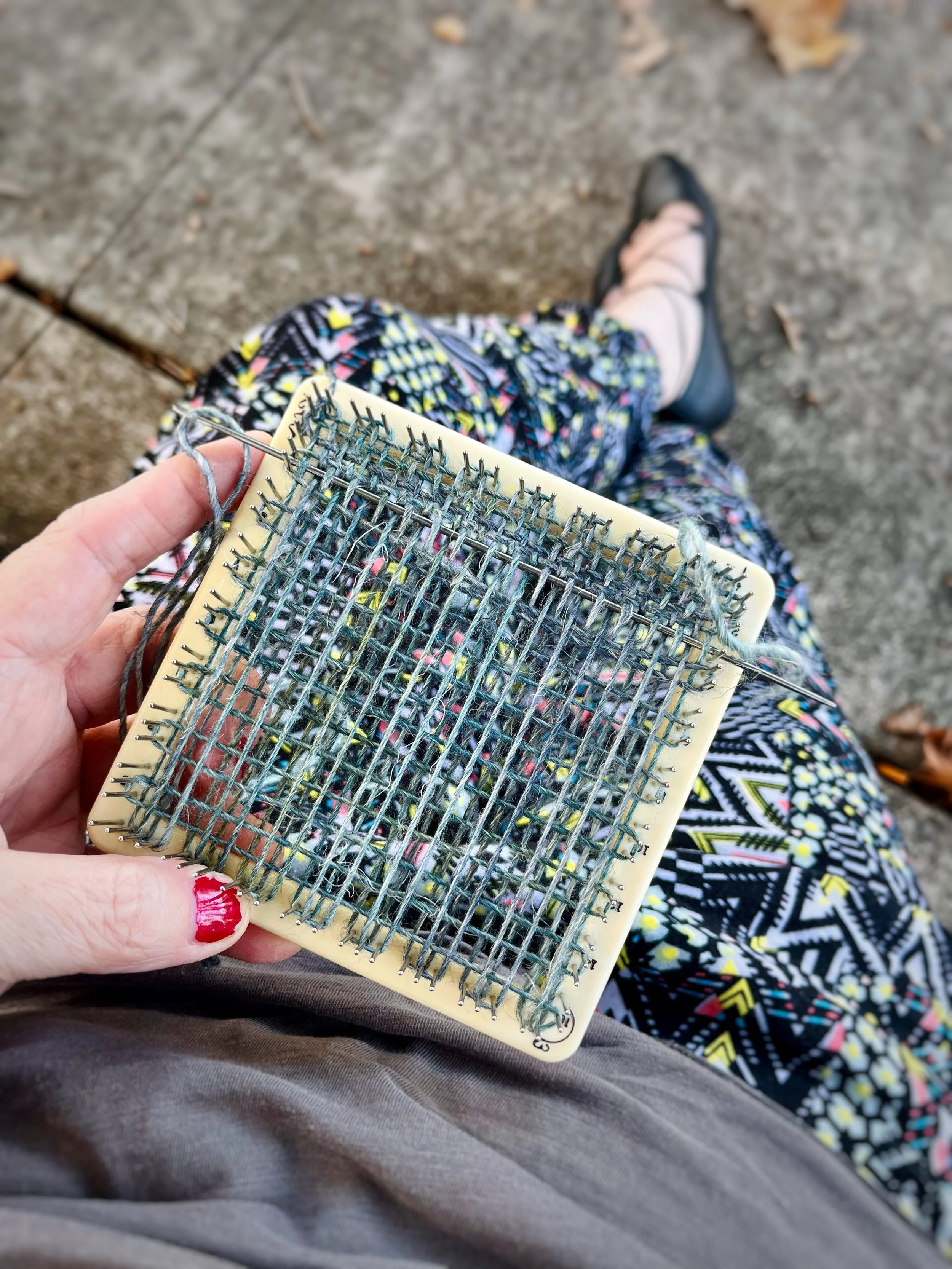
Weaving a small square on a vintage Weave-It pin loom, late autumn 2025 in Williamsport, PA. (See my note below.)
Creation Belongs to Everyone
It matters to mention that not all creators are artists.
Creation belongs to anyone who gives shape to something in a new or fresh way. Maybe it’s a home-cooked meal, a solution to a problem, a grounding ritual, or a way through difficulty. Creativity is not a category or a credential but a way of engaging with the world attentively.
The habit of creating is not about protecting an identity, but about protecting a relationship with curiosity, with sensation, and with joy.
Life Is the Special Occasion
This essay is being written during a season when many people are marking holidays. These moments of gathering, giving, and ceremony matter. But importantly, they are not the only times joy is allowed to surface.
One of the quiet lessons of my life has been this: joy does not require permission. It does not need a calendar date or a sanctioned reason to exist. The act of making—of noticing, shaping, and offering—is already a form of celebration.
Even in the chaotic religious setting of my childhood, I found peace in small acts done with care. In the ordinary made meaningful through attention.
I still do.
The habit of creating is, in part, the practice of remembering that life itself is the occasion. Being alive is reason enough to participate.
A Note on Pin Looms & Early Core Memory
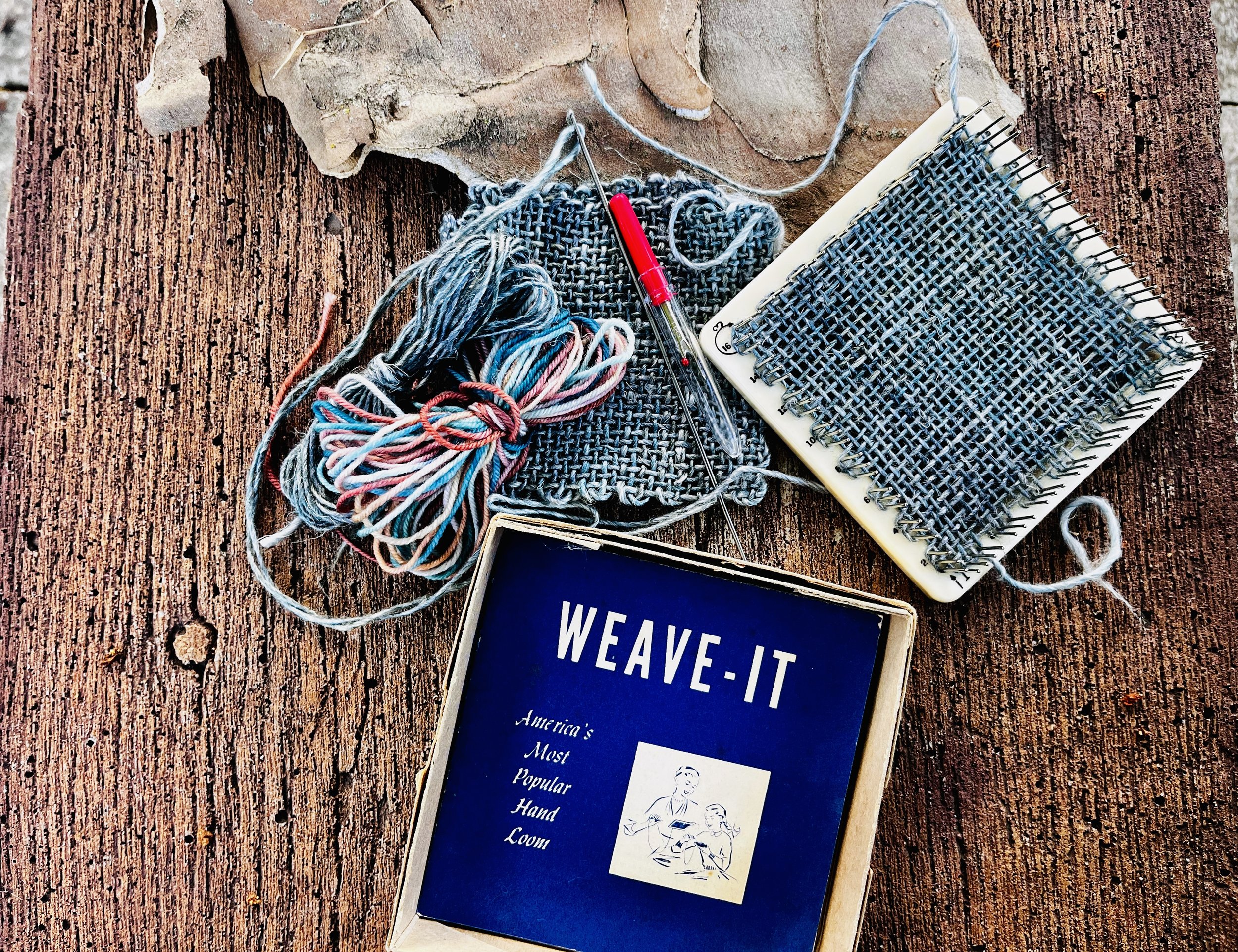
Weave-It pin loom kit, thrifted for $3 in Lancaster, PA.
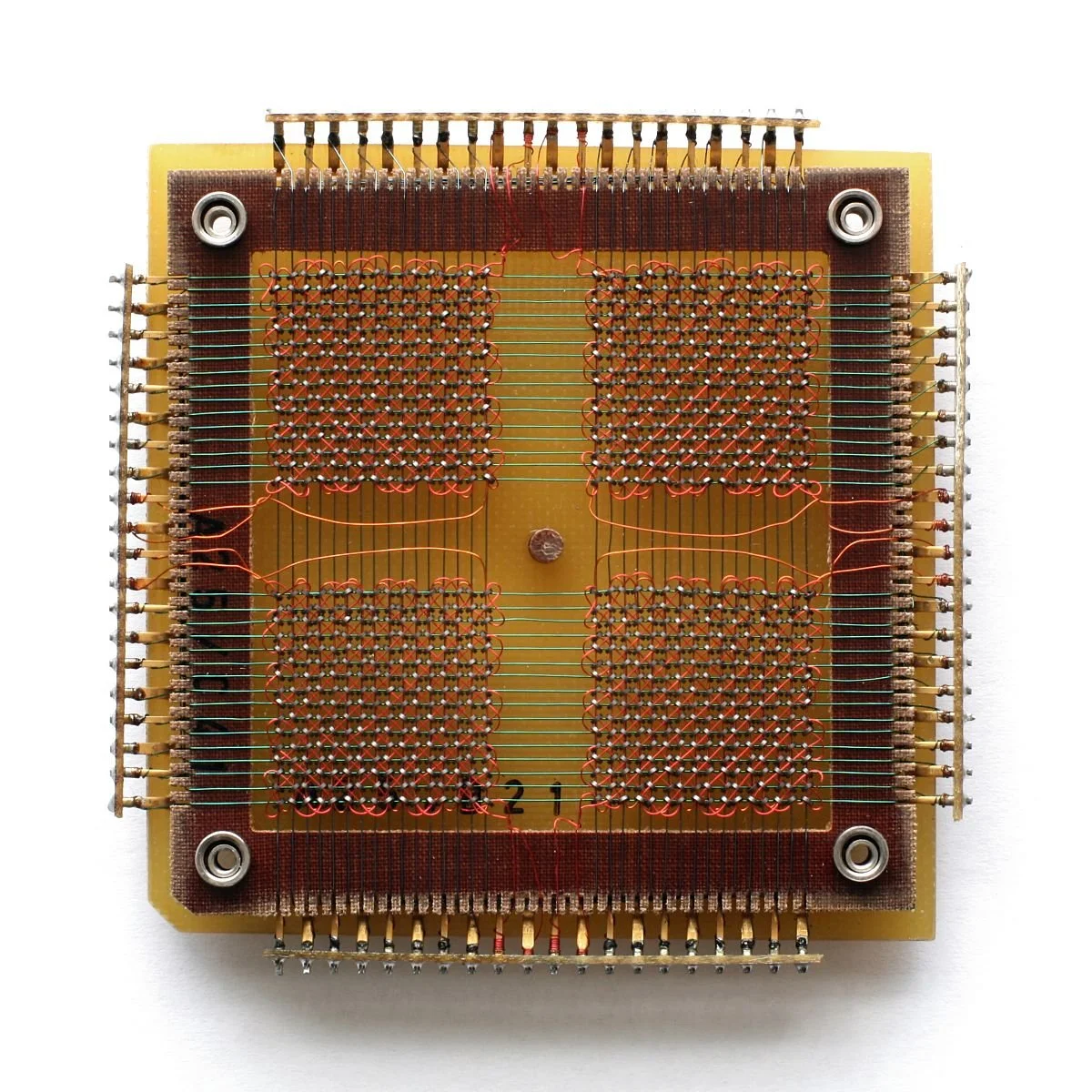
Handwoven core memory. Image: Konstantin Lanzet/Wikimedia Commons
In the post titled From Jacquard to GPUs: The Textile Origins of Computing, I wrote about Raytheon’s Little Old Ladies (AKA LOLs) who literally wove early core memory boards for computing.
When I thrifted my little pin loom, I couldn’t help but notice the resemblance and feel a sense of community.
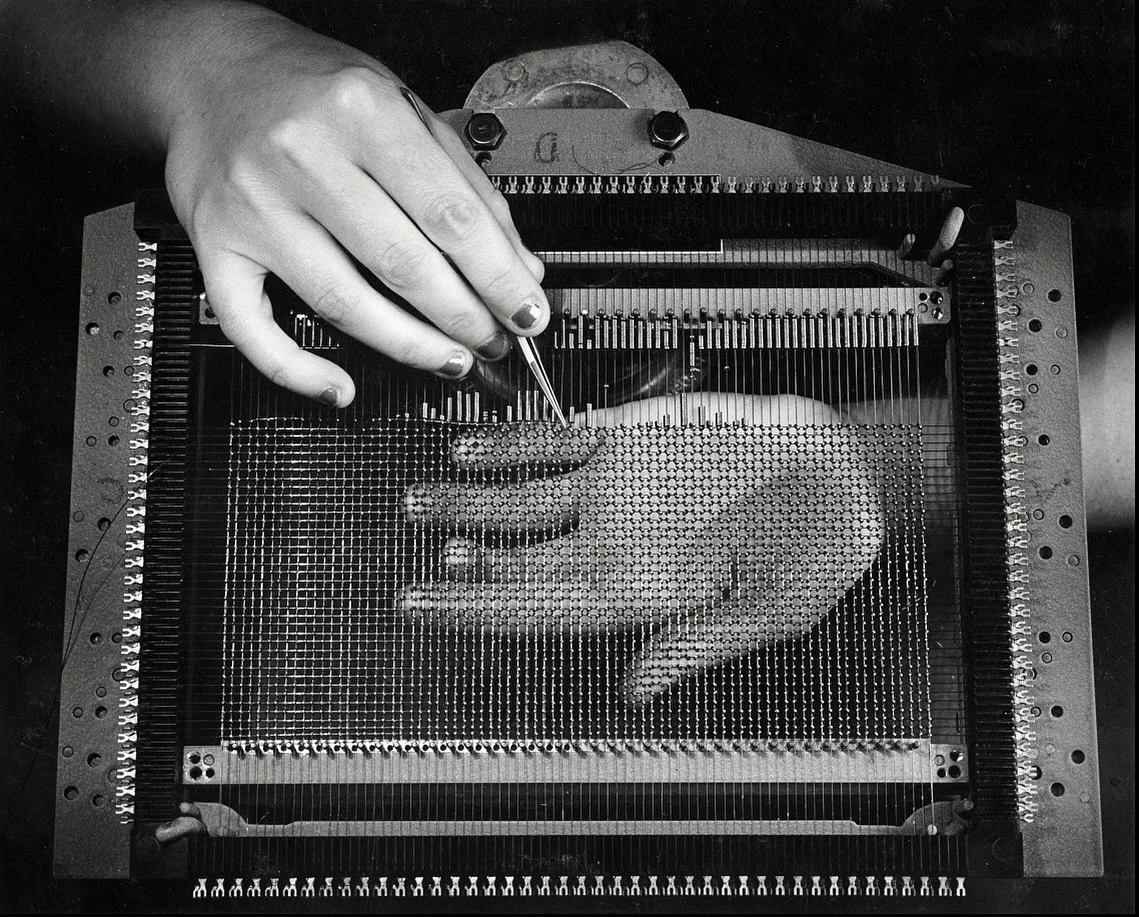
‘Hands weaving magnetic-core memory, IBM, Poughkeepsie, New York,’ 1956. Photograph by Ansel Adams
Goodbye, Hello, Repeat: On Reinvention
Since leaving Texas in March 2024, my life has been in a state of near-constant motion. Most recently, I packed what mattered, stored what could wait, and moved north to Williamsport, PA with a dismantled loom and some trekking poles in the backseat sanctuary of my car.
Since leaving Texas in March 2024, my life has been in a state of near-constant motion.
I got divorced. I moved. I left a job. I found a better one. I moved again. I deconstructed a life I had outgrown and have been slowly, deliberately building one that fits. Most recently, I packed what mattered, stored what could wait, and moved north to Williamsport, PA with a dismantled loom and some trekking poles in the backseat sanctuary of my car.
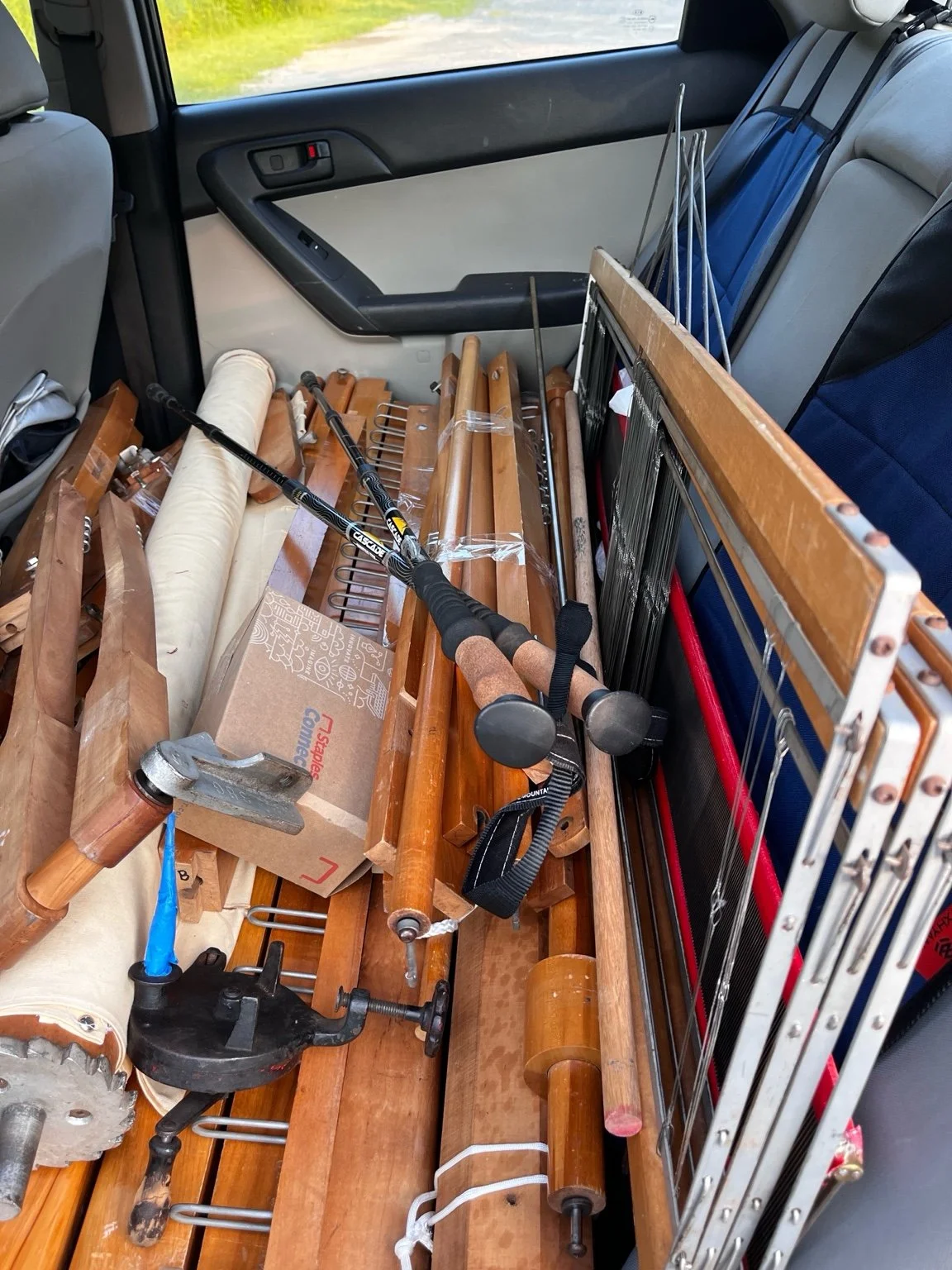
Keeping it real.
Weekdays are spent learning a new job where I help antique barns find new homes in new ways.
Evenings are in Airbnbs.
Weekends, I head for the mountains, hiking through woods and scrambling through creek beds until I am pleasantly exhausted.
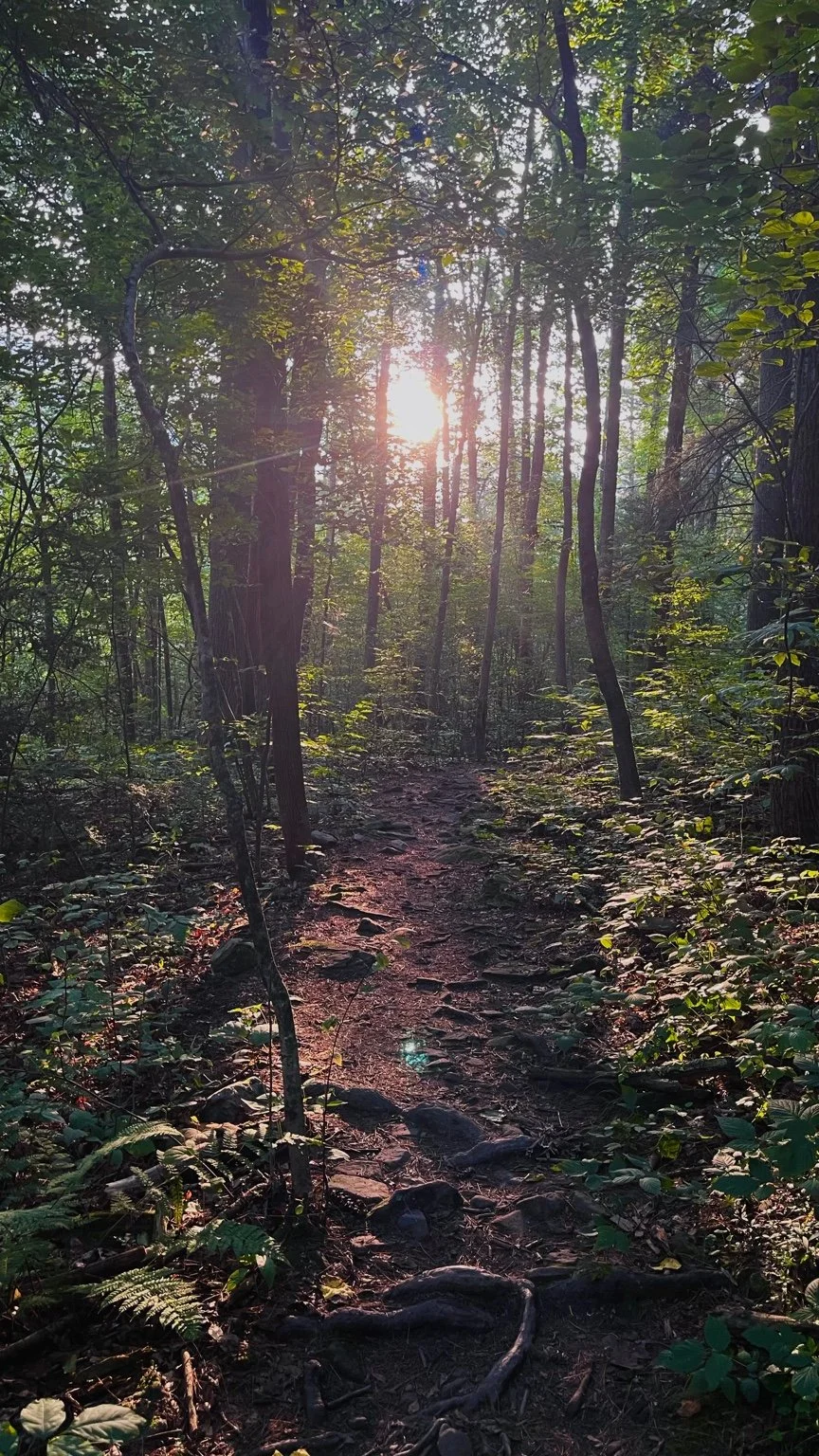
Some local trail to some local falls near sundown.
Choosing Change
This isn’t the first time I’ve started over, but this time feels different. This time it wasn’t forced; it was chosen. After years of feeling stagnant, I desperately wanted change. I wanted movement, growth, even uncertainty if it meant I could feel aligned again.
I sure got it.
I’ve still shown up to responsibilities, still paid the bills and did the work. But I’ve also made space to listen to what was quietly yet insistently asking to shift.
The Quiet Work of Reinvention
There’s a myth that reinvention belongs to the young, but I’m watching that idea unravel as I edit the first manuscript of a wonderful man in his 80s who is still evolving, still saying yes to new projects, still welcoming reinvention even when it demands vulnerability. His story reminds me that learning doesn’t stop. Curiosity doesn’t fade, and neither does the ability to change.
Reinvention isn’t an always grand announcement. Sometimes it’s a quiet series of choices: what to carry, what to leave behind, which direction to walk next. For me, it’s staying centered and grounded in my self while leaving plenty of room for the unknown.
One of the places I visited recently for work was a barn built over 150 years ago. Sunlight filtered softly through worn slats in weathered siding, illuminating rough-hewn beams and hand-forged fastenings. That space wasn’t built to be beautiful, but it practically resonates with beauty. It holds layers of use, weathering and care. Walking through it reminded me that solid foundations will hold even when everything around them shifts.
How centering.
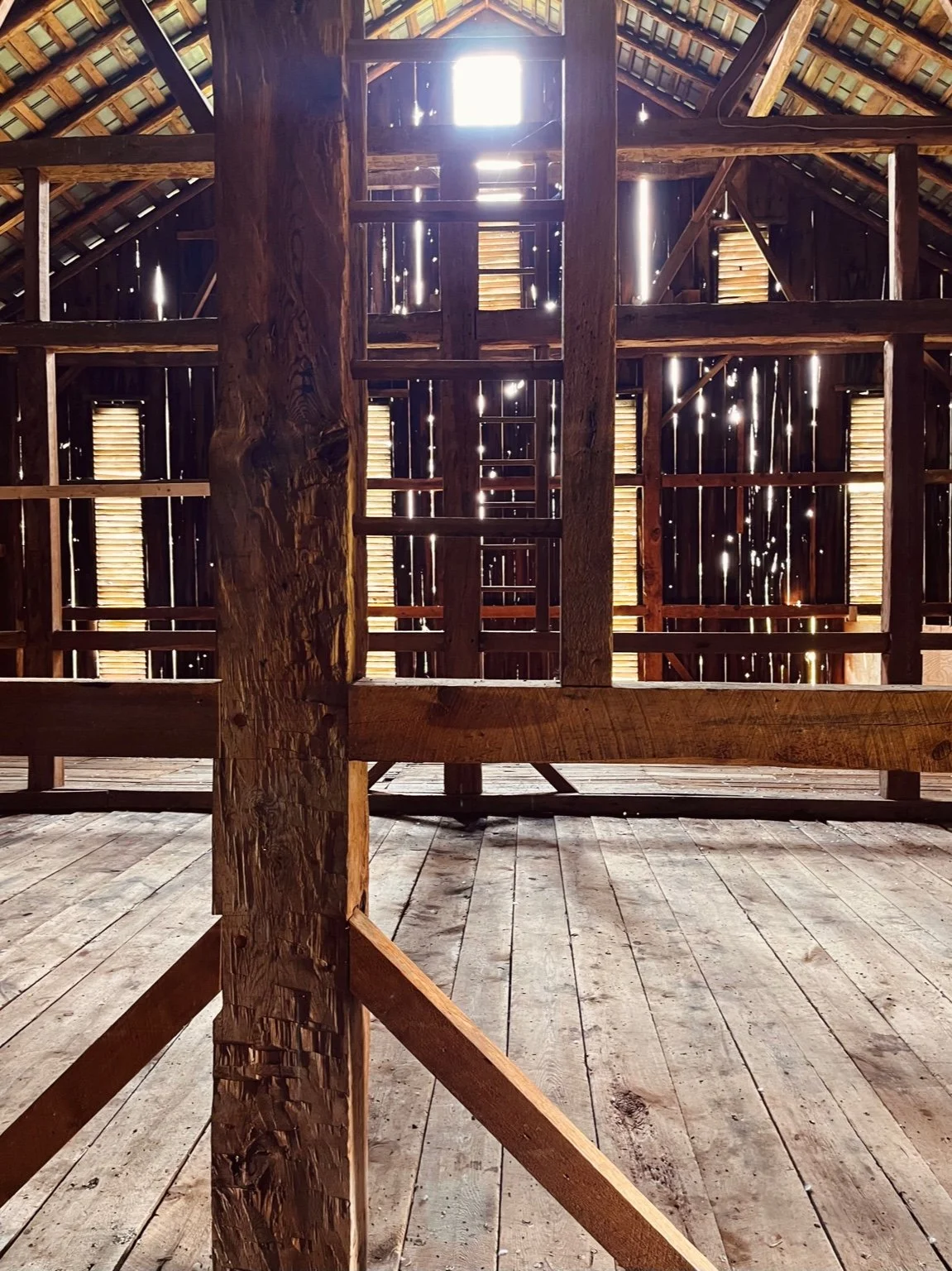
150+ year old barn looking every beautiful bit of its age.
A Pattern Begins to Form
What I’ve learned in this season is that reinvention isn’t about becoming someone else, but becoming more fully myself. It’s a quiet and deliberate series of small decisions, of steadily releasing what no longer fits. It’s letting the dog off the loom to make room for joy. It’s saying goodbye to roles or routines that once made sense, and welcoming in new beginnings that may not be fully formed but are worth trusting anyway.
I’ve said a lot of goodbyes this past year, to places, to people, and to older versions of myself. But the hellos are starting to outnumber the goodbyes.
Hello to wooded mountain trails and old barns beginning new lives.
Hello to unfamiliar streets and uncertain routines.
Hello to a version of myself I’m rising to meet.
Much like a new weaver, I’m still finding my rhythm. But slowly and surely, a pattern is beginning to form.
When It’s Right, It’s Right
One recent evening after work, I inquired about a rental tucked into a quiet corner of an 1800s building. I toured it on a whim, not expecting to like it much. It was was small and old and weird, and it felt right.
I turned to the woman showing it and said I was interested. I mentioned being a quiet tenant, and that my main hobby was weaving.
Her eyes lit up. “You’re a weaver?! I’m a weaver!” she said.
It turns out she studied weaving in school and is as devoted to the fiber arts as I am. We hugged. Then I showed her the backseat of my car.
Hello, new home. Hello, new friend.
I believe in slow craft, real connection, and thoughtful conversation. If something in this post sparked a question or memory, reach out! I’d truly love to hear from you. -Karri
In Good Company: Finding Community Through Fiber Arts
When you picture a fiber artist at work, you might imagine someone alone at a loom, lost in the quiet rhythm. Or maybe you see a knitter tucked into the corner of a couch, tea nearby, soft music in the background. These images are accurate.
But fiber arts have never existed only in isolation.
When you picture a fiber artist at work, you might imagine someone alone at a loom, lost in the quiet rhythm. Or maybe you see a knitter tucked into the corner of a couch, tea nearby, soft music in the background. These images are accurate.
But fiber arts have never existed only in isolation.
For as long as humans have worked with thread, fiber has brought people together. Around hearths, under trees, and in communal courtyards and spinning circles, fiber has been a point of connection.
It’s how knowledge was passed. It’s how stories were shared. And in many cases, it’s how communities held themselves together, literally and figuratively.
Modern connection might look different than it did generations ago. Maybe you meet fellow fiber artists at a guild meeting, a workshop, or a local yarn shop’s knit night. Maybe you find them through Instagram, Discord, or a quiet corner of Ravelry.
If you’re lucky, connection finds you.
A few weeks ago, I saw a Leclerc counterbalance loom listed on Facebook Marketplace. It was local(ish)—about an hour and a half away—but priced well beyond my $100 budget. I messaged the seller anyway, just to comment on her lovely loom and politely ask if her price was negotiable. In the conversation that followed, I learned she was leaving her longtime teaching job and letting go of the loom she'd used in her classroom.
I was between jobs, too, with very little income but a deep need to weave on a floor loom and experience creative flow, which I talked about in this post.
She ended up gifting me the loom, refusing any payment. “Just come get it,” she said. “This loom helped me through some hard times. I hope it brings you the same comfort.” She even included a weaving bench.
I was giddy.

A pile of beautiful maple “loom bones” waiting to be reassembled.
I met her at the school during off-hours and gifted her a beautiful piece from a local potter to show my appreciation. Then I dismantled the vintage Leclerc Mira loom for transport, reducing it to the bundle of sticks nearly every loom is at heart. This was familiar territory; I’ve worked on many looms before.
Over the course of a week, I gave the loom the care it needed: new cords, brake adjustment, tightened bolts, a bit of oil, etc. Once it was whole again, I selected a pattern from handweaving.net and got to work creating a warp from some recently thrifted wool.

Braided warp of sport-weight wool, warped for handweaving.net pattern #33584
Her act of generosity reminded me how much we rely on one another, even in a craft that often looks solitary from the outside. That gifted loom hasn’t just helped me make cloth; it serves as a reminder that behind every finished piece is a web of shared knowledge, quiet encouragement, and unexpected kindness.
That kind of connection doesn’t only come from big gestures, though. Sometimes it shows up in much smaller ways. Sometimes it’s as simple as commenting on someone’s weaving progress or swapping book recommendations online. These small gestures remind us that we’re not working in a vacuum.
The truth is: you don’t have to be a social butterfly to benefit from community. You don’t have to be the loudest voice in the room or someone who loves group projects. You can be someone like me, someone who prefers quiet mornings and solo projects, and still find deep value in being part of something bigger.
Because community isn’t just about company. It’s also about connection.
Where to Find Connection
Local Yarn or Fiber Shops (LYS)
Knit nights or drop-in hours where you can bring a project and chat
Classes in everything from felting to lace knitting to rigid heddle weaving
Access to unique tools and yarns you won’t find online
Connection to local teachers, events, and other makers
Fiber Festivals & Fairs
Vendors offering hand-dyed yarns, handspun fibers, and artisan tools
Demonstrations in weaving, spinning, dyeing, or felting
Workshops taught by experienced fiber artists
Encounters with fellow makers that often spark new friendships
Guilds & Weaving or Spinning Groups
Monthly meetings with guest speakers or show-and-tell
Hands-on workshops and skills exchanges
Lending libraries of books, patterns, or equipment
Mentorship opportunities with experienced members
Community Centers & Libraries
Craft classes or fiber arts workshops for all ages
Drop-in sessions where you can bring your own project
Bulletin boards and flyers for local events and maker gatherings
Online Communities
Instagram & TikTok: Use hashtags like #fiberarts or #weaversofinstagram
Ravelry: A classic home base for knitters and crocheters
Discord & Slack: Niche fiber communities for everything from spinning to natural dyeing
Newsletters & blogs: A low-pressure way to connect and learn asynchronously
Workshops & Retreats
Weekend or weeklong retreats in beautiful locations
One-day intensives in local studios or art schools
Hands-on instruction and creative connection with fellow makers
New relationships that often continue beyond the retreat
For the Homebodies
Quiet curiosity is still my default mode. My studio (meaning wherever my tools are) is where I’m most myself, surrounded by yarn, tools, and music.
But even from that quiet corner, connection still finds me. Through students. Through kind emails. Through a stranger who gave me her loom and wished me well.

Progress pic. Shirt by a talented dyer over at peace, love and happy dyes
While solitude is part of my creative process, even the most hardcore homebodies need community sometimes, we just tend to engage with it differently.
Even the most independent makers can benefit from moments of shared understanding. It’s good to be reminded that your curiosity, your care, your process, all of it lives in a larger ecosystem of making.

Yards of my colorful handwoven wool cloth destined to be accent pillows, once I rehab my thrifted vintage sewing machine (hello, future blog post!)
We may not need to weave our own cloth to stay warm these days, but making something from start to finish still matters. It builds patience. It teaches problem-solving. It connects us to a slower, more deliberate way of living.
The cloth I wove on my newly restored loom—gifted by a fellow maker—isn’t perfect. But it’s mine. Every pick and color choice holds a piece of a story: of generosity, repair, and return.
Whether you’re stitching, spinning, or weaving some cloth, you’re not just making a thing. You’re joining a lineage of makers who understood the value of working with their hands, and who found comfort and connection in the doing.
Have a question? Want to share your latest project? I’d love to hear from you! Get in touch or sign up for my newsletter for occasional updates, resources, and upcoming events.
From Jacquard to GPUs: The Textile Origins of Computing
Weaving and computing might seem worlds apart—one ancient and tactile, the other sleek and digital—but their histories are intertwined.
Weaving and computing might seem worlds apart—one ancient and tactile, the other sleek and digital—but their histories are intertwined. From punch card looms and traditional textiles to memory boards and smart fabrics, common threads run through the story of technology, threads often held by hands that have long gone unacknowledged.
The logic that underpins modern computing is literally and metaphorically woven; textile innovation threaded its way into mathematics, data processing, medicine, aerospace, and even the way your graphics card schedules work.
That same way of thinking about pattern, structure, systems, and how things work together informs my work designing websites for artists, makers, authors, and creative businesses.
Explore my website design work»
Jacquard Cards: The First “Program”
In 1801, Joseph-Marie Jacquard introduced a loom controlled by punch cards, rectangles of stiff paper pierced with holes that dictated which warp threads would be raised.
This innovation allowed weavers to produce complex brocades without memorizing patterns or repeating them manually, dramatically increasing both efficiency and precision.

Model of a Jacquard loom with punch cards. Image: Science Museum Group
Woven cloth is formed by the interlacing of warp and weft threads. Weaving patterns are often visualized as grids showing where these threads cross over or under each other. Typically, a weaver reads each line of a pattern and manually raises or lowers warp threads accordingly.
Jacquard’s punch cards automated this process: each combination of holes corresponded to a specific sequence of lifted warp threads. For the first time, the instructions for a machine's operation were stored externally, in a reusable, modular format. By 1812, more than 11,000 Jacquard looms were in use, transforming the textile industry and prefiguring the logic of modern programming.
The loom was revolutionary not just for fabric, but for the way it modeled thinking. Among those inspired by its logic was Charles Babbage, a British mathematician and inventor often called the father of the computer.
Intrigued by the concept of automating complex operations through external control, Babbage carried samples of Jacquard punch cards in his coat pocket. He incorporated the same principle into his design of the Analytical Engine, a mechanical computing device capable of performing calculations based on stored instructions.

Plan diagram of Babbage’s Analytical Engine
But it was Ada Lovelace, a gifted mathematician and writer (and daughter of poet Lord Byron), who fully grasped the machine’s broader potential. In 1843, while translating a paper on the Analytical Engine, Lovelace added a series of notes that far outshone the original text.
She proposed that the machine could manipulate not only numbers but symbols, producing patterns, even music, if given the right instructions. To her, it was a loom for logic. Lovelace famously wrote that the Analytical Engine could “weave algebraic patterns just as the Jacquard loom weaves flowers and leaves.”

1871 experimental design of Babbage’s Analytical Engine. Image: Computer History Museum
The idea that a physical pattern could encode and transmit instructions didn’t end with Lovelace and Babbage. It reappeared in the work of Herman Hollerith, an American inventor who developed a punch card system to tabulate the 1890 U.S. census. Hollerith’s method encoded data using holes in cards and fed them into electromechanical readers.
The result? A process that had taken seven years to complete in 1880 was shortened to just a few months.
While Hollerith’s punch cards didn’t operate looms, they followed the same fundamental logic: data could be stored, processed, and interpreted by encoding it physically. His work laid the foundation for modern data processing—and for IBM, the company that would grow out of his Tabulating Machine Company.

IBM punched cards. One card contained the equivalent of a single line of code. Image: IBM
In this way, the Jacquard loom’s influence extended far beyond the textile industry. Its use of repeatable, external instructions helped establish an entirely new way of thinking about information: pattern as data, yarn as bit, cloth as computation.
The loom didn’t just automate fabric; it became the conceptual prototype for the programmable machine.
Woven Memory: From Spools to the Moon
More than a century after Jacquard’s loom first punched its way into history, the logic of weaving helped launch spacecraft. In the 1960s, the Apollo Guidance Computer (AGC)—used on every crewed Apollo mission—required a form of memory that was compact, lightweight, non-volatile, and rugged enough to survive the jostling, vibration, and radiation of space travel.
The solution was a remarkable technology known as core rope memory.
At first glance, core rope memory doesn’t resemble any computer hardware you might recognize. It looks more like intricate textile work: bundles of copper wire threaded through or around tiny magnetic ferrite rings, arranged with astonishing precision.
These wires, stitched by hand, determined the ones and zeroes of the software. A wire threaded through a ring represented a binary 1; a wire bypassing the ring represented a 0. This created a form of read-only memory (ROM) where the program was literally woven into physical form.

Handwoven core memory. Image: Konstantin Lanzet/Wikimedia Commons
The work of creating this memory fell to women employed by Raytheon, NASA’s hardware contractor. Many came from textile backgrounds, and the job required a level of focus and dexterity on par with fine needlework. In photographs—including a striking one by Ansel Adams—you can see women seated at stations, threading delicate wire through dense fields of cores, building the code loop by loop. Engineers referred to them, half-jokingly, as “LOLs” or Little Old Ladies, though many were young and highly skilled.
What these women were doing wasn’t just manufacturing, they were programming by hand. Each memory module contained up to 192 bits of information, and each was triple-checked for accuracy.
It’s said that one misplaced wire could cause a catastrophic guidance failure. And yet, they built thousands of flawless modules. Dolores “Dee” Bracey, one of the core memory weavers interviewed later in life, said, “I had no idea what I was building, just that it was important.”
The AGC flew with only 64KB of memory and a processor slower than a modern digital watch, yet it performed flawlessly. The software woven by these women controlled the spacecraft’s navigation, descent, and ascent. It guided astronauts to the Moon and brought them safely back.
The poetic truth here is that the success of a lunar mission rested on something fundamentally familiar: careful, intentional threadwork.
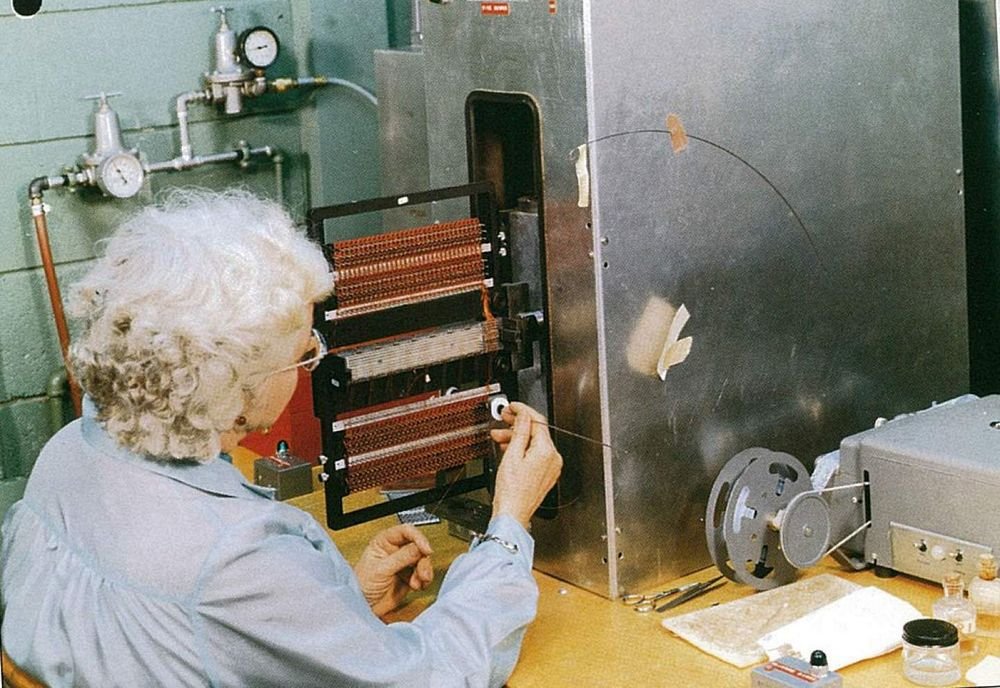
Raytheon technician weaving core rope memory.
What’s more, this wasn’t the only time weaving logic merged with space-age tech. Core rope memory offered far higher density than the ferrite core memory used for read/write tasks. It was slow to produce but virtually indestructible once built—perfect for a one-way ticket to the Moon.
Though the contributions of these women were largely unrecognized at the time, modern historians and technologists are beginning to acknowledge their impact. The visual similarity between textile work and early hardware wasn’t accidental—it was part of a longer legacy of women's labor in computing, often under-credited and mislabeled as “nontechnical.”
In core rope memory, we see the loom evolve once again: this time not into metaphor, but into machine. Weaving, long thought to be the domain of soft goods and soft skills, became the literal infrastructure of one of humankind’s greatest technical achievements.
You can try your hand at "weaving" your own memory over at Core64—a hands-on educational kit that pays homage to Apollo's core rope memory. (Currently tops on my birthday wishlist.)
Navajo Women and the Racialization of Early Electronic Manufacturing
While NASA’s core memory modules were being assembled in Massachusetts, another form of handwork was unfolding in Shiprock, New Mexico. In the late 1960s, Fairchild Semiconductor opened a large microchip assembly plant on Navajo land, employing over a thousand Navajo women to solder and assemble some of the earliest integrated circuits.

Navajo woman working at microscope. Image: Computer History Museum
The company’s public rationale was striking: they believed that Navajo women were well-suited to the work because of their background in weaving and other traditional crafts. Executives praised their "innate dexterity," linking the precision required for soldering fine electronic components to the intricate threadwork of rugs and tapestries.
On the surface, it seemed like a celebration of Indigenous skill, but beneath that framing was a more complicated and troubling reality.
As media and cultural scholar Lisa Nakamura argues in her groundbreaking essay Indigenous Circuits, this connection between weaving and electronics was used not to elevate the status of these workers, but to justify their low wages and precarious labor conditions.
By casting the work as “natural” and culturally intuitive, Fairchild sidestepped the need for training, minimized recognition, and erased the technological nature of what these women were doing.
The irony is sharp: while American media in the 1960s often portrayed Native communities as "pre-modern," their labor was powering the cutting edge of modernity, feeding directly into the rise of Silicon Valley and the global tech industry. The Shiprock plant operated for about a decade before closing in the 1970s, leaving behind little formal acknowledgment of what these women contributed.
Photographs from the time show rows of women in lab coats and hair nets, hunched over circuit boards and microscopes. The tools may have changed, but the posture of concentration would be familiar to any weaver.
“The work of Indigenous women was central to the transformation of the U.S. economy from industrial to informational, yet their role has been largely overlooked.”
Like the punch card and the core memory wire, the soldered circuit board becomes another medium where textile logic meets information logic. But in this story, the labor is not only under-credited, it’s also racialized, gendered, and ultimately discarded once no longer deemed cost-effective.
This section of computing history reminds us that the metaphor of weaving in technology is more than poetic. It’s political. The loom, again, is both a tool of creation and a lens for understanding whose hands build the future and whose stories are written out of it.
From GPUs to Smart Textiles
Though the loom’s influence is deeply rooted in computing history, its threads continue to surface in some of today’s most advanced technologies, including the way your computer’s graphics card processes data.
Take your computer’s graphics card. When it renders smooth motion, glowing effects, or detailed shadows, it does so using tightly coordinated bundles of parallel threads. In NVIDIA’s CUDA architecture, these bundles are fittingly called warps.
A warp consists of 32 threads that execute instructions in lockstep. This isn’t just poetic naming; it reflects the structural logic of parallel computing. Much like warp threads on a loom remain in tension while the weft moves across them, GPU threads stay synchronized as they work together. If one thread in the group diverges or stalls, the whole warp slows down, so harmony and alignment matter as much in code as in cloth.
Programming languages carry this textile legacy in their vocabulary: we spin up threads, weave routines together, join or detach them. Even error handling sometimes refers to threads that have been cut, broken, or unraveled.
These terms persist because they reflect the deeply patterned logic required to manage concurrency and complexity in modern software. The vocabulary of weaving persists because it continues to map so naturally onto how we structure behavior, timing, and coordination in code.
“ The vocabulary of weaving persists because it continues to map so naturally onto how we structure behavior, timing, and coordination in code.”
This same logic is literally woven into the fabric of emerging technologies like smart textiles and e-textiles. These garments and surfaces integrate conductive threads, sensors, and sometimes microcontrollers. They flex and breathe like traditional cloth but act as interactive interfaces, measuring heart rate, tracking motion, or triggering LEDs. While the fabric itself isn’t running code, it enables code to react to physical input: motion, temperature, pressure, or touch.

Pressure sensors are woven into plastic-yarn textiles called 3DKnITS. Image: Irmandy Wicaksono.
Beyond fitness wearables and fashion, these fabrics are making their way into military, aerospace, and industrial applications. Researchers have developed uniforms that track soldiers’ vitals and transmit real-time data.
Aircraft seats detect pressure points and adjust dynamically. Hospitals now test smart bedding that can alert nurses when a patient hasn’t moved, helping prevent bedsores and improving care. In each case, the textile itself becomes a sensor platform: soft, flexible, and intelligent.
What’s striking is that the circuitry isn’t glued on after the fact; it’s woven in. Conductive fibers, often made from silver or carbon, are integrated alongside cotton, bamboo, or synthetic yarns. They bend. They rustle. They wash and wear. New standards like IPC-8921 are being developed to ensure these smart fabrics hold up through repeated stretching, laundering, and daily use.
Pattern Thinking: Weaving as Structure and System
Look under the hood of modern mathematics and you’ll find a surprising amount of textile metaphor: knots, nets, meshes, interleaving. These metaphors aren't just poetic; they inform real models and algorithms in computer science. From mesh networks to data interleaving in digital communication, the logic of weaving continues to offer a functional blueprint for building systems, structuring information, and solving problems. Weaving offers a natural blueprint for balance, structure, and beauty. The loom gives us a way to see how seemingly chaotic threads can form a coherent whole.
From Jacquard’s punch cards to lunar navigation and smart textiles, the logic of weaving continues to thread its way through technological progress. What began as a method of organizing threads on a loom has evolved into a conceptual framework for organizing data, structure, and logic across disciplines. In every example—from code stitched into Apollo memory to warps inside your graphics card—textile thinking isn’t just inspiration. It’s infrastructure.
And yet, these connections often go unnoticed. The language of weaving persists quietly in tech, math, and medicine, shaping our tools, our metaphors, and the very structure of information systems. What might change if we saw those threads more clearly? If we acknowledged not just the logic of weaving, but the labor—and the people—who wove their way into the digital age?
Follow the Thread: Further Reading & Resources
This post touches just part of a much larger, fascinating story. Here are a few recommended resources if you’d like to explore further:
"Core Memory: Weavers of the Apollo Guidance Computer"
Science News
Read it here →
A richly detailed look at the women who built the AGC's woven memory modules by hand."Indigenous Circuits" by Lisa Nakamura
American Quarterly
PDF →
A foundational essay on Navajo women’s labor in chip manufacturing and how it was framed by race and gender."Weaving, Coding, and the Secret History of Women’s Work"
Fast Company
Read it here →
A wide-angle view of textile labor and its role in early computing."When Women Stopped Coding"
The New York Times Magazine
Read it here →
How the demographics of programming shifted from female-dominated to male-dominated—and why."Woven Memories: Core Rope Memory and the Space Race"
SparkFun Blog
Read it here →
A technically rich but approachable dive into how rope memory worked and why it mattered."Smart textiles sense how their users are moving"
MIT News Office
Read it here →
How researches developed a form-fitting fabric that recognizes the wearer’s activity.
Making things work together.
My interest in structure, systems, and thoughtful design extends beyond the loom. I also build websites for artists, makers, authors, and creative businesses.
A Dog on the Loom: The Art of Letting Go
It's that stubborn project that began with a burst of excitement and the best of intentions, but somewhere along the way, it simply fizzled.
You have a dog on the loom.
It's that stubborn project that began with a burst of excitement and the best of intentions, but somewhere along the way it simply fizzled. Maybe the colors don't sing the way you imagined, or the pattern feels flat and uninspired. Maybe life intervened, and the project sat neglected, gathering dust and judgmental side-eyes from across the room.
Now it’s more than just a problematic warp: it’s a hulking, guilt-laden shadow that camps out in your creative space. A strong-but-silent type, weighing down both your loom (or needles, canvas, etc.) and your spirit.
You've invested time, money, and creative energy. You told yourself you should finish it. After all, you started it.
The truth? You have what’s known in the weaving world as a dog on the loom.
Recognizing the Dog on the Loom
How do you know if your project has crossed over into dog territory? There are some tell-tale signs:
You avoid your loom (or other creative tool) entirely.
The thought of working on it brings more dread than joy.
You're forcing yourself to continue out of guilt or obligation.
These are gentle signals from your creative self that something's amiss. A reminder that some projects are lessons, not masterpieces.
The Art and Science of Letting Go
Recognizing when to let go is part of the creative process. It's an act of courage, not defeat. In fact, research shows that embracing the fresh start can renew motivation, reduce creative burnout, and open pathways for innovation.
Psychologists refer to this as the "fresh start effect," a phenomenon where temporal landmarks like the start of a new week encourage people to detach from past failures and approach goals with renewed vigor. These resets can fuel forward momentum by psychologically separating us from what went wrong before.
In weaving, this can translate directly to cutting off an old warp and giving yourself the gift of a blank loom.
Moon and… spider? Pac Man, maybe?
I had warped my inkle loom with what I thought was a striking combination of yarns: rich plum, sunlit gold, and terracotta. They looked great side-by-side on cones, and I envisioned a band featuring a radiant sun and moon motif woven in supplementary weft technique, bold and symbolic. I drew up my pattern and warped the loom with full confidence.
But once I started weaving? Meh.

My most recent dog, but neither my first nor my last.
The pattern was questionable. My teenager squinted at it. "Is that supposed to be Pac Man... and a spider?"
I couldn’t find anything about it to love. The warp sat for months. I told myself I should reimagine the pattern, or maybe just weave a plain band and be done with it.
But I loathed it. I avoided it altogether, daydreaming about other things I'd rather weave while too guilt-stricken to cut off a perfectly good warp. It stole not just my time but my enthusiasm for the entire process.
One day, frustrated with more pressing concerns and needing creative outlet, I made the cut. The relief was immediate and visceral. The scrap became a bookmark. Some warp was wasted, yes. But in its place? Space for a new project, one that brought me back to the quiet, tactile joy of cloth forming beneath my fingers. Back to the curiosity, the play, the gentle rhythm—the very things that first pulled me into this work and keep me coming back.
What Happens When You Let Go?
There’s a term called the sunk cost fallacy. It's the tendency to persist in an endeavor because of what you've already invested, even when the best course is to walk away.
We all know a thing or two about this, don’t we?
Clinging to a project that no longer serves you carries as emotional toll. So despite all outward appearances, letting go isn't about wastefulness. It's about honoring your present self and creative energy.
When you free up that psychic space, you're inviting in new ideas, fresh color palettes, and different textures. You're creating the conditions for creative flow to return.
When you release a dog on the loom, several things happen:
Creative Renewal — You make space for curiosity and play to return.
Skill Reflection — You can extract lessons learned from the project without forcing completion.
Emotional Clarity — You free yourself from guilt and frustration, clearing the path for joy to re-enter the studio.
Studio Energy Shift — That lingering unfinished piece no longer drains your energy every time you walk by the loom.

The joyful project that replaced the dog—destined to be a strap for my favorite leather bag.
Letting go can be a radical act of self-care. It's giving yourself permission to fail forward, to embrace the imperfect, and to remember that creativity thrives in spaces of openness, not confinement.
Letting Go of Expectations vs. Just Letting Go
I approach my creative projects the way I approach life—by letting go of expectations and releasing the rigid picture of how things should turn out. I do my real or proverbial math, follow the process, and hope for the best. This mindset allows me to stay in the present while remaining open to surprises. Rather than hanging all my satisfaction on the outcome, I can find joy and satisfaction in the process.
It doesn’t always work.
Even after releasing expectations, some projects remain a drain on your energy. So how do you know when it’s time to let go of expectations and when it’s just time to let go?
Ask yourself:
Does the project still spark curiosity when I release my original expectations?
Do I feel excitement if I allow myself to play, without worrying about results?
Or does the project feel like a chore, even when I try to let go of outcome?
If the first two resonate, letting go of expectations might open doors. If the third feels true, it might be time to cut the dog off the loom and create space for what's next.
Learning to hold both kinds of letting go side by side is a creative superpower. It invites both resilience and discernment—qualities that help us navigate not only our weaving projects but life itself.
From Dog to Discovery
Weaving teaches us patience and persistence, yes—but also discernment. Not every project needs to be wrestled into submission. Sometimes, the most generous thing we can do is let the dog off the loom and set it free.
And what about that leftover warp, those half-woven inches? They can still find a second life:
Cut up for samples.
Used in mixed media art.
Repurposed into tassels and other weaving finishes.
Reimagined into coasters or bookmarks.
Used as fodder for blog posts

Finished handwoven crossbody strap, courtesy of letting the dog off the loom.
Ready for a Fresh Start?
Are you clinging to a dog on the loom? What might open up if you made space for what's next? What creative corners could you explore if you gave yourself the freedom to begin again?
Starting over isn't a step back—it's a leap forward, fueled by everything you've learned along the way.
Need help sorting your creative projects or breathing new life into your studio? I offer personalized guidance for weavers and fiber artists in the greater Northeast PA area, including those stuck with a stubborn 'dog.'
The Radical Stitch: Fiber Arts as Resistance
For as long as there has been cloth, there have been people using it to speak, survive and defy. The history of textiles is not just a history of beauty, it’s also a history of rebellion.
Fiber arts are often described as delicate, domestic, and soft. They’re associated with quiet moments, cozy rooms, and patient hands. And while these descriptions aren’t untrue, they leave something important out: the edge.
For as long as there has been cloth, there have been people using it to speak, survive and defy. The history of textiles is not just a history of beauty, it’s also a history of rebellion.
Fiber arts don’t always raise their voices. But they don’t need to. They persist, quietly. They witness, call out, resist, and remember.
Throughout history, people have turned to thread not just for function or expression, but for resistance and survival. Some stitched in protest, some in mourning. Others embedded codes into cloth, creating acts of quiet defiance hidden in plain sight.
Knitting and Espionage in Wartime
During both World Wars, knitting was a patriotic act; also, at times, a covert one. Women would knit messages in Morse code, or pretend to knit while observing, secretly tapping messages in Morse code with their foot while others jotted them down.
In Belgium, women reportedly sat by rail lines and knitted coded messages into scarves to track German troop movements, dropping or adding stitches to signal patterns.
The British Office of Censorship was so concerned about the potential use of knitting for secret messaging that they banned sending knitting patterns through the mail.
In WWI, suspicion was so high that governments warned against unknown women knitting for soldiers, fearing spies could embed Morse code into garments.
The act of knitting became more than craft—it became cover.
Arpilleras of Chile
Under the brutal Pinochet dictatorship in the 1970s and 80s, Chilean women began creating arpilleras, small hand-stitched narrative tapestries made from scraps.
They depicted protest marches, soldiers, poverty, and missing family members. Smuggled out of the country in laundry bundles or care packages, they bore witness to the brutality that couldn’t be published in the press.

Chilean arpillera. Photo courtesy of molaa.org.
Labeled “tapestries of defamation” by the Pinochet regime, many arpilleras were seized and destroyed. Their makers stitched in secrecy, signing only with initials to avoid arrest.
Holocaust Survival and Resistance
In Nazi concentration camps, some women were assigned to textile work details—mending, sewing uniforms, even embroidery. Within this forced labor, they still found ways to resist.
In Auschwitz, 25 young Jewish women worked in the Upper Tailoring Studio, a dressmaking salon created to serve the wives of Nazi officers, including Hedwig Höss. Led by Marta Fuchs, a skilled seamstress, these women sewed luxurious garments under the gaze of their captors. Yet even in that unimaginable setting, they supported one another, using their craft and quiet solidarity to not only survive, but to help others by smuggling messages and other items in and out of Auschwitz.
Read more about The Dressmakers of Auschwitz at Lilith.org.
Hmong Story Cloths
Displaced by the Vietnam war, Hmong refugee women began stitching pa ndau, or “flower cloths.” These story cloths recorded scenes of village life, migration, and survival.

Story cloth. View and learn more story cloths at garlandmag.com.
In their stitches were memory, grief, and truth. These visual testimonies helped preserve identity, and told stories that might otherwise be lost across borders or generations.
Civil Disobedience: Taking the Wheel
One of the most iconic examples of fiber as resistance is Gandhi’s spinning wheel movement in India. In the early 20th century, Gandhi encouraged people to reject British-manufactured cloth and instead spin their own yarn on a charkha—a small, hand-powered spinning wheel.
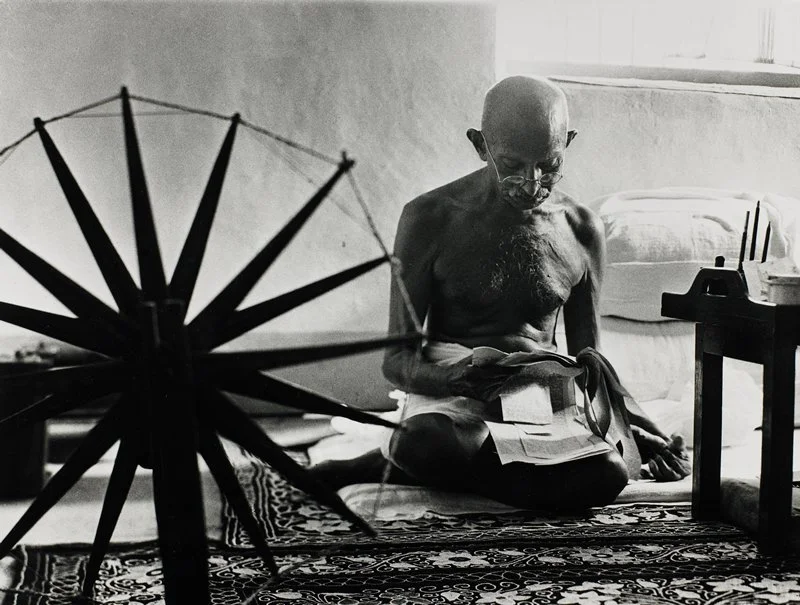
Ghandi and his Charkha wheel. Photo by Margaret Bourke-White
This wasn’t just about economics; it was a deeply symbolic act. To spin thread was to reclaim autonomy, to reject imperial control, and to restore dignity through self-sufficiency. The act of spinning became a daily meditation on freedom, and the charkha itself was so central to the movement that it became featured on the early flag of independent India.
Like many acts of fiber rebellion, it was humble in its tools and profound in its message: power can reside in the smallest, most intentional gestures.
The Bayeux Tapestry
Created in the 11th century, the Bayeux Tapestry depicts the Norman conquest of England. While often viewed as propaganda, as documented over at historycoloredglasses.com, it also demonstrates how narrative power could belong to the needle.

Detail from the Bayeux Tapestry.
Made by women, it recorded history from a uniquely textile perspective, reminding us that cloth has long been a medium of documentation, not just decoration.
Don’t Forget the Pussyhats
In more recent years, the Pussyhat Project turned knitting needles into megaphones. Pink hats worn by marchers across the globe signaled unity, bodily autonomy, and the reclamation of visibility. What began as a grassroots effort to create a sea of hand-knit protest wear for the 2017 Women’s March quickly grew into an international movement. The project reclaimed both color and craft, using traditionally feminine aesthetics to deliver a pointed political message.

Source: The Pussyhat Project
Why Fiber Resists So Well
Cotton, linen, wool and silk may seem unlikely media for rebellion, but that’s part of their power; they move quietly but remain visible.
It’s portable. A scarf, a patch, a bag—all can carry message and meaning.
It’s domestic. What was once considered private, “women’s work,” becomes a subversive public statement.
It’s accessible. Thread is humble. It’s forgiving. It’s available.
It’s personal. One person can tell an entire story with just their hands.
Fiber also invites community: spinning circles, weave-alongs, mending groups. These aren’t just hobbies, they’re networks of knowledge, resilience and care.
My Quiet Acts of Rebellion
I’ve been resisting with thread for a long time, though I didn’t always have a name for it.
We were very poor when I was growing up. I joke that we were so poor my father and I once shared a coat, meaning only one of us could go out at a time—a true story.
My family ran an upholstery shop out of the basement for a while, and as a young teen I’d sneak downstairs late at night. In the few dark hours my night-owl parents slept and before the newspaper bundle for my morning route hit the porch, I’d dig through discarded scraps of vinyl and floral brocades. I’d stitch them into handbags, alter my hand-me-downs, or sew pillows I could quietly sell.
I wasn’t trying to be an artist; I wanted to feel capable in a world that didn’t often offer me that feeling. Those early stitches were a form of self-determination.
Years later, as a single mother and returning student with no extra income, I built my first loom from sticks in the yard. It was a backstrap loom assembled with borrowed yarn and blurry instructions from the internet. (Slightly updated backstrap weaving instructions by the fabulous Laverne Waddington.)
I didn’t wait for the right tools or training, I just began. I needed to see what was possible with what I had. The loom wasn’t pretty, but it worked. It taught me that we don’t have to be resourced or ready or perfect to begin something meaningful, or to make.

Blurry old picture of one of my first backstraps looms in action, this one a super-fancy dowel version.
Still later, when I was pregnant with my daughter and placed on strict bedrest—facing the very real possibility that she might be born far too early—I turned to knitting. I felt like my body had betrayed me. I was frightened and uncertain. But learning a new skill lent me confidence, and the act of knitting offered rhythm. Each knit or purl stitch was a deliberate tether to hope, a way to reestablish trust in my own body, and an intention to bring something beautiful into the world despite the fear.
And I did. She was born full term. I remain an avid knitter.

Learning to knit while on bed rest. Squeaks was my constant companion.
These weren’t grand gestures of political or historical importance, but they mattered. They were moments when I chose making over waiting. They were small revolutions that helped me claim time, agency, and much-needed meaning.
Soft Work, Sharp Message
Fiber arts are a long, continuous thread of meaning that connects us to the makers who came before us, those who stitched in protest, stitched in grief or fear, stitched in survival. We may very well be those makers. Or we may teach the next generation of quiet rebels. And so the thread continues.
Whether you’re sewing a protest patch or weaving a vibrant wall hanging, whether you’re just learning to cast on or mending a well-worn sleeve, you are participating in something deeper than craft. You are continuing a tradition of making that has always included care and courage in equal measure.
And in today’s world, where speed is king, and making by hand is often dismissed as a luxury, choosing fiber arts is already a form of rebellion. It’s a decision to stay close to process, to value slowness, and to care about what you create.
So pick up the thread, even if your hands shake. Disrupt the status quo. Begin again, even if you’ve had to begin before. You are not alone.
I believe in slow craft, real connection, and thoughtful conversation. If something in this post sparked a question or memory, reach out. I’d truly love to hear from you. -Karri
The Power of Whimsy: On Creating Just Because
There’s often an unspoken message that unless your art is producing income, it’s not “real.” Unless it’s deep or dramatic or politically urgent, it’s not important. Unless it’s being seen or sold or published, maybe it doesn’t count.
I don’t believe that.
There’s a certain seriousness that can settle over creative work if you’re not careful. You start out making something for the joy of it, but somewhere along the way, you begin to hear the questions: What are you going to do with it? Are you going to sell it? Are you trying to go full-time?
There’s an unspoken message beneath those questions: unless your art is producing income, it’s not “real.” Unless it’s deep or dramatic or politically urgent, it’s not important. Unless it’s being seen or sold or published, maybe it doesn’t count.
I don’t believe that.
I believe there’s a quiet, essential power in creating something just because. Just because it’s joyful. Just because it makes someone laugh. Just because you couldn’t not make it. Even if it’s a little weird. Even if it’s wildly impractical. Even if it’s… a life-sized needle-felted Baby Yoda.
This is the Way
Back when the Mandalorian was still in its first season and the world hadn’t yet caught up with the overwhelming cuteness of Grogu, I was commissioned to make one for a nominal fee by a fellow Star Wars fan. Not a plushie. Not a figurine. A full-size, hand-felted Baby Yoda.
There were no patterns. No tutorials. No kits or pre-made accessories. I started with what I knew—needle felting—and made the rest up as I went. I sculpted his head and features by hand, carefully layering shades of green and adding subtle variations to give his skin that worn, otherworldly look. I gave him glass eyes and that slightly worried, slightly curious expression we all fell in love with. Then, I designed and sewed him a coat from scratch, complete with weathering, folds, and just the right amount of oversized collar.

Baby Yoda waiting patiently for his body.
I didn’t make it because I thought it would sell like hotcakes. It didn’t; don’t come for me, Disney. I didn’t have a business plan. I wasn’t trying to break into the collectible doll market. He was never going to sit on a gallery pedestal. I just really wanted to make him. And I wanted to see if I could.
Whimsy as Our First Language
Before we learn to write our names or tie our shoes, we draw. Toddlers with crayons or chalk gripped in full fists cover pages, sidewalks, and walls with unfiltered color. Lines go nowhere. Faces melt into scribbles. The point isn’t precision but joy. They draw with complete freedom, oblivious to critique, immune to self-consciousness.
That is creation in its most human form.
We’re born to make marks. To shape, to decorate, to mimic, to invent. The impulse to create lives in us before we have language for it. And the desire to make something that sparks joy, to draw a cat with ten legs or a dragon wearing a party hat, isn’t childish. It’s true.
I’m reminded of that every time I make something that exists purely because it delighted me to do so.
Tiny Footsteps and Big Impressions
More than twenty years ago, I visited the Museo Nacional de Antropología in Mexico City. I still think often of one particular artifact I saw there: the Codex Boturini, a pictographic manuscript documenting the Mexica people’s migration from Aztlán.
What I remember most? Tiny footsteps.
Across the pages, little footprints march between hand-drawn scenes, guiding the viewer through the story. It was playful, almost whimsical, and yet deeply meaningful. A child could follow it; so could a scholar. It didn’t need words to lead you.

Page from the Códice Boturini, or Codex Boturini. You can view the full manuscript at archive.org.
That image has stayed with me all these years. It reminds me that whimsy has always had a place in human storytelling. That joy is a kind of meaning.
When Art Is Play
Somewhere along the way, many of us get the message that “real” art has to be serious. That it needs to be deep or tragic or laborious to be valid. That cute is frivolous. That fun is a phase, or that whimsy is indulgent.
But the truth is, whimsy has always had a place in art. The oldest textiles feature fanciful motifs, exaggerated animals, and bright, joyful colors. The marginalia of medieval manuscripts are full of little creatures. Folk art is bursting with humor, exaggeration, and delight. Art history is full of makers who played, who laughed, who let their curiosity guide them even when it didn’t “make sense.”

Whimsical margin art from a medieval manuscript. Image source.
Whimsy isn’t shallow; it’s a form of connection. A way to say, this made me smile, and I hope it makes you smile, too. It bypasses pretension and goes straight to the part of us that still wants to be surprised.
The Pressure to Monetize Everything
We live in a culture that loves a side hustle. If you’re good at something, people will tell you to open an Etsy shop, sell patterns, or go pro. And if that’s what you want, wonderful! There’s nothing wrong with turning a passion into a business.
But not every act of making needs to lead somewhere profitable. Not every project has to be “productive.” Some things are worth doing because they light you up. Because they restore your creative rhythm. Because they remind you that you’re allowed to play.
When we lose that, we lose something vital. We begin to see our creativity only through the lens of output and income. We begin to hesitate before trying something new because we can’t see how it “fits.” We talk ourselves out of projects that are too silly, too strange, or too joyful.
But here’s the thing: sometimes those are the projects that bring us back to life.
Whimsy as Process, Not Escape
Creating something whimsical isn’t about avoiding depth. It’s not the absence of meaning; it’s a different kind of meaning. One that embraces lightness and honors curiosity. One that lets go of outcome and allows for wonder.
When I made Baby Yoda, I wasn’t ignoring the world. I was entering into it in a different way. I was noticing texture, and proportion, and expression. I was thinking about how we bond with fictional characters, and how faces convey emotion, and how storytelling extends into craft. I was fully immersed. I was in the process.

And that’s what I want more of, for myself, and for others. I want us to make things that don’t have to defend themselves. I want us to say yes to ideas that seem a little absurd. I want us to let creativity be light sometimes, not as a way of avoiding seriousness, but as a way of balancing it.
If someone sees your work and laughs with delight, or says “oh my gosh, that’s the cutest thing I’ve ever seen” then you’ve done something real. You’ve stirred emotion. You’ve invited them into your creative world.
Joy is a legitimate outcome. So is awe. So is play.
Not all art needs to be gallery-worthy. Not every piece needs to carry a thesis. Sometimes, it just needs to remind someone that they’re human. That there’s still softness. Still delight. Still a moment of “look what someone made with their hands.”
Give Yourself Permission
So here’s my invitation to you: make something silly. Make something tiny and delightful and completely impractical. Something your 9-year-old self would enjoy. Make something that makes you giggle while you work on it. Something that you don’t have to show anyone, or something you can’t wait to share. Just make.
You don’t need a business plan. You don’t need a reason. You don’t need to be taken seriously to be taken meaningfully.
Sometimes, the most freeing thing you can do for your creativity is let it be light. Let it be weird. Let it be yours.
Whimsy isn’t the opposite of art. It is art.
If You're Nearby...
If you’re in the Williamsport, PA area and need guidance to start or rekindle your creative journey, contact me and let’s work together!
How to Set Up a Creative Space for Fiber Arts (No Studio Required)
When people picture a creative workspace, they often imagine the kind of dreamy setup you’d see in a magazine with sunlight filtering across a vintage loom.
But let’s be real.
When people picture a creative workspace, they often imagine the kind of dreamy setup you’d see in a magazine: sunlight filtering across a vintage loom, yarn arranged by color in antique baskets, a spinning wheel in the corner, and not a single tangled thread in sight.
But let’s be real.
Most of us don’t live in houses with spare studios or the luxury of leaving things out all the time. We share space with families, roommates, pets, and real life. And yet, beautiful, meaningful creative work still happens.
You don’t need a studio. You just need a little space.
And that space doesn’t have to be permanent or perfect, it just has to be yours, even if only for a little while. Whether you're brand new to fiber arts or returning to them after a long break, this post is here to help you carve out a spot in your home, your day, and your mindset for the joy of making.
Small Space, Big Potential
Your creative space doesn’t have to be a room. It can be a corner, a tabletop, a tray, or even just a sturdy basket you pull out when it’s time to work. What matters isn’t size, it’s intention.
Case in point: in 2019, I shared a 1,200 square foot, 2-bedroom apartment with my then husband, our two daughters, two dogs, two cats, and a turtle named Cornelius. Space was at a premium, but I’m a creator with a need to create, so I got creative. I claimed a section of living room wall that got great natural light, and that’s where I did all my fiber arts for the better part of the pandemic.

My former fiber arts “studio” setup in a small apartment.
If you have a spare wall or corner, or even a closet, dresser, or bookshelf, then you’re in luck! Even a single drawer or tote can hold more creativity than you think.
Flexible Space Ideas
A bookshelf or cabinet: Assign one shelf (or even half) for yarn, tools, or work-in-progress. Use baskets, bins or even tote bags to group by type. Add a small tray for tools you reach for often.
A chest or storage ottoman: These make great dual-purpose options for storing roving, yarn, and looms while doubling as seating or surfaces.
A closet: Even a single shelf or hanging organizer can transform a forgotten closet into a fiber arts command center. Tuck in a folding chair and table and add a clip-on LED light, and you have instant (and portable!) studio setup.
A wall space: Pegboards, wall hooks, or hanging baskets can keep tools visible and easy to access. Even a mounted dowel rod equiped with “S” hooks can hold multiple small looms or neatly draped skeins. Look for multiple-use items, like a bench with storage underneath or wall shelves with added pegs/hooks. Don’t be afraid to use every inch of space creatively!
You don’t need custom furniture, you just need a clear plan. And if planning or organizing your space feels overwhelming, I offer creative space setup support. Just shoot me an email and let’s discuss your goals.
Whether we’re working in person or via Zoom, with what you already have or figuring out what to shop for and where, I’ll help you create a space that supports your creativity.
Before I began teaching fiber arts, I spent years in the home interior design and décor industry, collaborating with designers to craft spaces that reflect the personality and needs of their owners. That experience now helps me guide students in shaping spaces that are not only functional, but truly theirs.
Essential Tools for Getting Started
You don’t need a huge collection of supplies to dive into fiber arts. A few well-chosen tools will serve you across multiple crafts, and you can always build your toolkit as you go. Once you get started, you’ll find tools and equipment everywhere!
Here are some basics I recommend for weaving, knitting, and felting:
Weaving Essentials
A small frame loom or rigid heddle loom
Yarn for both warp and weft (start with smooth, worsted-weight yarns)
Shuttle(s) and tapestry needles
Ruler or measuring tape
Scissors—the sharper the better
Optional: masking tape, shed stick (paint stirrers work great!), comb or fork for beating in rows depending on your loom type
Knitting Essentials
Knitting needles (wood or bamboo are great for beginners—try US size 8 or 9)
Worsted-weight yarn in a light color (easier to see your stitches)
Tapestry needle for finishing
Stitch markers (or paperclips)—I’ve used small loops of yarn
Measuring tape
Scissors
Felting Essentials
Wool roving in a few colors (not superwash wool which doesn’t felt!)
Felting needles (start with a multipack)
A piece of foam or brush mat to protect your surface
Optional: finger guards, cookie cutters for shaping, or small molds
For wet felting: bubble wrap or a sushi mat, spray bottle of soapy water, large towel, plastic to protect your work surface (optional)
Multi-Use Tools
Small scissors or yarn snips
Tapestry/darning needles
Measuring tape
Notebook or sketchpad
Clips or clothespins
A bag, bin, or basket to keep everything together
There’s no need to gather it all at once. I often tell students to begin with what they have, or borrow before they buy. Some of the most inventive work comes from limited tools and a little curiosity.
Create a Ritual Around Your Space
Your space doesn’t have to be elaborate, but it can still be meaningful. Think of it like a mini-ritual, something that gently shifts you into creative mode.
You might:
Brew a cup of tea or light a candle before you begin
Put on a favorite playlist or podcast
Start by winding a ball of yarn, petting your fiber (ahem, yes please), or sorting colors—something simple to ease in
Keep a little notebook nearby for ideas, reflections, or project notes
Scroll through Ravelry for inspiration—but not for long! The whole point is to get making
When you’re done creating for the day, take a moment to put things away with care. This creates a full cycle of opening and closing your creative time, helping it feel special, even sacred. I’m a big believer in the power of fiber arts and presence.
A Note About Claiming Space
For some of us, setting aside time and space for creativity can feel indulgent—or even selfish. Especially if we’re caretakers, busy professionals, or have been taught to prioritize productivity over play.
But here’s the truth: making time and space for creative work is a gift to yourself and to the people around you. It feeds your mind, centers your body, and keeps you connected to something real. It doesn’t need to take over your whole life to improve the quality of it.
“...making time and space for creative work is a gift to yourself and to the people around you.”
Going back even further in my fiber arts journey, I had only a cozy corner off my kitchen to work with. I say cozy, but really it was the noisy hub of our tiny home. Nothing a pair of cheap headphones and an audiobook couldn’t conquer. I had only a small yarn collection, a single rigid heddle loom, and a handful of tools. Was it still my happy place?
Yes. Yes, it was.

A quiet corner with some natural light and a few shelves is as much a fiber arts studio as a dedicated room.
You don’t need a full-size studio. You don’t need the perfect setup. You just need a place to begin, and the belief that your creativity deserves room to grow.
Bringing Your Space to Life
Whether you’re setting up in a corner of your living room or unrolling a backstrap loom across the dining table, your space is enough. And if you’d like someone to guide you through that beginning—someone who has worked in less-than-perfect spaces with makeshift tools and limited budgets—I’d love to help.
My one-on-one lessons are designed to meet you exactly where you are, literally and creatively. I bring the tools, the patience, and the experience to help you build skills and confidence in the space you already have.
Curious? You don’t have to be “ready.” You just have to start.
Why Fiber Arts Matter Now More Than Ever
In a world of endless scrolling and instant results, there is something quietly radical about fiber arts. To sit down and weave, to knit row after row, to coax felt into form with the slow rhythm of a needle; these are not acts of urgency. They are acts of attention.
In a world of endless scrolling and instant results, there is something quietly radical about fiber arts. To sit down and weave, to knit row after row, to coax felt into form with the slow rhythm of a needle; these are not acts of urgency. They are acts of attention.
I came to weaving in a nontraditional way. I didn’t have money for a loom or lessons. I was a returning student, a single mother scraping together what I could. My first real loom was a backstrap loom I made from old wood dowels and sticks from my yard, and wove with a friend’s discarded yarn. I taught myself from the internet the same way I teach myself anything: piecemeal and imperfectly, but with quiet persistence.
What kept me going wasn’t just curiosity but something deeper; the act of making gave me a sense of agency I struggled to find elsewhere. I was tired, broke, stretched thin, but when I wove, I felt capable. I was doing something real, something rooted.
And I want others to feel that too.
A Return to the Rhythms of Our Hands
Fiber arts are ancient. We’ve spun, dyed, stitched, and woven for millennia. Long before we wrote in books, we told stories in cloth. We slow-crafted out of necessity. And while the need to make our own textiles has faded for many, the need to make has not.
In fact, I believe that need is growing. Now more than ever.
Modern life, by contrast, runs at a much faster pace. We’re surrounded by apps that refresh by the second and news cycles that change before we can even finish absorbing them. Meanwhile, fast-fashion machines produce thousands of low-quality garments per day.

Still from Yvonne, 1997 by Rosemarie Trockel. Part of Fast Fashion / Slow Art, a global conversation among artists on the effects of fast fashion.
Somewhere amid that speed and consumption, many of us have lost our sense of grounding.
Fiber arts bring us back to something tangible. Something tactile. They ask us to move slowly, repetitively, rhythmically. They ask us to count. To notice. To be with the material in our hands.
There’s comfort in that, and it's not just romantic nostalgia. The rise of knitting, weaving, and other crafts in recent years, especially among younger people, isn’t an accident. Platforms like TikTok and Instagram have seen a notable surge in DIY fiber content since the pandemic, driven by a need for creative grounding, self-regulation, and beauty that can be touched, not just clicked.
It makes sense. Fiber arts offer a place to put your attention when the world feels unsteady, a way to move your body when your mind needs stillness. A sense of rhythm when everything else feels out of sync.
Getting Into the Flow
The benefits of working with fiber are well documented. Knitting and crochet have been shown to reduce anxiety and depression, improve focus, and even lower blood pressure. Felting can provide a safe outlet for stress and emotion. Weaving, with its patterns and precision, can create a meditative state that’s similar to mindfulness practices.
“Knitting and crochet have been shown to reduce anxiety and depression, improve focus, and even lower blood pressure. ”
Psychologist Mihály Csíkszentmihályi called it flow: that feeling of being so fully immersed in an activity that you lose track of time. Many fiber artists know this feeling well. The soft hum of concentration, the way the world falls away for a little while; it’s not just pleasant, it’s healing.
Occupational therapists have known this for decades. Historically, fiber arts have also been used in occupational therapy and trauma recovery. After WWI and WWII, veterans were taught weaving and knitting to help rebuild fine motor skills and restore a sense of agency and rhythm.

Weaving as occupational therapy at Walter Reed General Hospital in Washington D.C. during World War I. Photo courtesy of otcentennial.org.
Mary Meigs Atwater, often credited with reviving American handweaving in the early 20th century, initially taught weaving as a form of therapy. She wasn’t just restoring a craft; she was restoring people.
There’s something inherently grounding about working with fiber. We engage our bodies, our eyes, our spatial awareness. We plan, we problem-solve, we make choices. And at the end, we hold something real in our hands, something that didn’t exist before.
Connection Through Craft
Fiber arts aren’t only personal. They’re relational. Shared.
Think of quilting bees, knitting circles, and communal dye pots. These crafts have always been about more than individual output. Historically, they’re about gathering, learning, witnessing one another’s hands at work. Even today, whether it's in a living room, a class, or an online group, fiber brings people together.
When I teach fiber arts, whether it's weaving, knitting, or felting, I get to witness a kind of gentle transformation in my students. I see them soften into the process. I see the satisfaction in making something real. I hear the shift in their voice when they say, “I made this.”
There’s pride, yes. But there’s also connection. To the materials. To themselves. Sometimes, to a memory.
That kind of connection is something many of us crave. We’re hungry for meaning, for creative control, for something to hold. Fiber arts offer that, quietly, reliably, and without requiring perfection.
A Living Lineage
What I also love about fiber arts is that they are democratic. They belong to no one and everyone. Every culture on earth has some relationship to fiber, to cloth, to basketry, to thread. These practices transcend class and age and geography.
“Every culture on earth has some relationship to fiber, to cloth, to basketry, to thread.”
Some of us were lucky enough to learn fiber arts at the side of a grandmother or neighbor. Others, like me, pieced it together through scraps of online tutorials, donated yarn, and trial-and-error on homemade looms. But no matter how we come to it, we join a lineage that stretches back generations.
There’s something powerful in that. Something steadying. When we weave or knit or felt, we’re not just making, we’re participating. We’re adding our voice to a long, unbroken thread of creativity and survival.
Not Just a Craft
For me, fiber arts aren’t a hobby but a practice. A way of moving through the world. A way of making room. For slowness. For self-trust. For imperfection.
They teach patience, presence, and problem-solving. They show us how to follow a thread, how to undo a mistake, how to begin again. These lessons aren’t confined to the loom or the needles. They carry over into daily life, into how we speak, how we care for ourselves, how we build things that last.
Fiber arts aren’t the only way to get there, of course. But they are a way. And a beautiful one at that.
So Why Does It Matter Now?
Because we need something steady. Something we can return to when the noise gets loud. Because in a world of automation and overstimulation, there is power in doing something slowly, deliberately, and with your own two hands.
Because making something meaningful is a way of making meaning at all.
Fiber arts matter because we matter. Our attention matters. Our process matters.
And in this moment, when so much asks us to rush, to consume, to disconnect, fiber arts gently ask us to do the opposite.
To slow down.
To connect.
To create.
And to remember that even the smallest thread, when woven with intention, can become something strong.
If You're Nearby...
If you’re in the Williamsport, PA area and need guidance to start or rekindle your creative journey, contact me and let’s work together!
What Weaving Taught Me About Patience
I used to be impatient. Not in an obvious way, but in that quiet, restless need to move on to the next thing. I liked results, finishing, progress.
Then I found weaving.
I used to be impatient. Not in an obvious way, but in that quiet, restless need to move on to the next thing. I liked results, finishing, progress.
Then I found weaving.
Every weaving project begins with a warp, and every warp begins the same way—with math. You calculate the sett, consider fiber type, shrinkage, the finished dimensions. You estimate yardage, sometimes with trial and error. It’s not hard math, but it requires focus. One small miscalculation can throw off the entire piece.
Then you measure each length of yarn on the warping board. A simple scarf woven on a 4-shaft floor loom might require hundreds of warp lengths in a predetermined pattern. It’s repetitive and exacting work. You count, loop, tie, adjust. You’re not weaving yet, but you’re laying the groundwork.

Warp of cotton, silk and wool yarns wound on a warping board. Warped for a 10” wide summer scarf.
After your warp is wound, you beam the warp onto the loom, threading each length into individual heddles. You sley the reed one thread at a time. The process varies with each loom type, but the process remains.
All of this happens before a single pass of the shuttle.
As a new weaver, I found this frustrating. It felt like a lot of effort just to begin weaving, which was all I wanted to do. There were so many steps between the idea and the cloth. So many chances to mess it up. So many moments that asked me to slow down when all I wanted was to see some progress.
But the more I did it the more I understood its value, and not just as a precursor to weaving.
Every step in the process matters; each step shapes the one that follows. If I rush, I pay for it later with tangles, tension issues, broken threads, or a fabric that doesn’t behave the way I hoped it would. There’s no real shortcut. The beginning is part of the cloth. Whether you took your time, whether you cared, it shows in the final cloth.
A Practice of Presence
Over the years and through the warps, weaving has taught me how to slow down and stay present. It’s made me more thoughtful, not just at the loom but in the rest of my life. I notice this when I prepare food more intentionally, or when I take time to clean up my workspace, or when I pause before reacting to something. I’ve come to see patience as a kind of quiet strength, a choice to stay engaged in the process.
There’s a kind of respect embedded in each part of the process. You begin to recognize it when you wind a warp without rushing, or when you fix a threading error instead of ignoring it (yes, I used to ignore it.) These aren’t delays, they’re opportunities to practice care.
And the effects spill over.
Now when I sweep the floor or prepare coffee or fold laundry, I find myself in a rhythm, not trying to get through it, but allowing it to be part of the day. Weaving helped me realize how many moments I’d been skipping over or skimming past. Not out of malice or neglect, but out of habit. Out of hurry.
Rainer Maria Rilke wrote:
“Have patience with everything unsolved in your heart and try to love the questions themselves…”
In weaving, so much is unsolved for so long. You don’t see the pattern emerge right away. You might not know how the cloth will drape, or whether your color choice will sing or fall flat. But you keep weaving. You trust the structure. You come back to it.
Eventually, you embrace it.


Homemade tensioned copper pipe loom, warped and ready to weave a small tapestry.
A Quiet Kind of Strength
I’ve come to see patience as a kind of intimacy, with time, with process, with material. It’s not something you either have or don’t. Patience is something you practice. You cultivate it, like any skill. Weaving just happens to be a particularly honest teacher.
There’s also humility in it; you can’t strong-arm a loom. You can’t force it to cooperate. If your warp tension is off, the loom will show you. Not out of spite, but out of truth. It reflects exactly what you put into it. That kind of honest feedback can be hard, but it’s also a gift. In weaving, you get the chance to begin again. To fix it. To adjust and keep going.
That lesson—start where you are, fix what you can, and keep going—has helped me far beyond the loom.
“That lesson—start where you are, fix what you can, and keep going—has helped me far beyond the loom.”
Patience now shows up in how I talk to others. How I listen. How I teach. It reminds me that progress is often invisible at first. That sometimes, laying a foundation is the work. That presence can be more valuable than speed.
And isn’t that what most of us are after in some way? Not just to make something, but to feel connected while we’re doing it?
Weaving has become a way for me to practice presence without striving. It’s not a meditation that requires stillness or silence, but one that flows through movement and rhythm. Through choosing to stay with the thread in my hands, even when my mind wants to wander to the next task.
If you’re someone who struggles with patience (like I did), weaving might offer more than a finished piece. It might offer a new way of approaching the rest of your day. It might shift how you interact with time, or how you treat the in-between moments of your life.
I believe in slow craft, real connection, and thoughtful conversation. If something in this post sparked a question or memory, reach out! I’d truly love to hear from you. -Karri