
Touch-Me-Not
I was fifteen, living in a new town — a village, really — waiting for the school bus at an overgrown stop I'd later learn nobody actually used. The village sat on the banks of the Susquehanna, and across the water rose the twin cooling towers of a nuclear power plant, quietly venting steam into the morning sky.
I stood there alone, early and a little anxious on an ordinary morning, the way you are when you're new someplace and haven't yet learned its rhythms.
Out of curiosity, I reached over and touched a seed pod on a plant growing beside the stop.
It burst instantly, curling back on itself and scattering seeds across my hand. It startled me so completely that I laughed out loud.
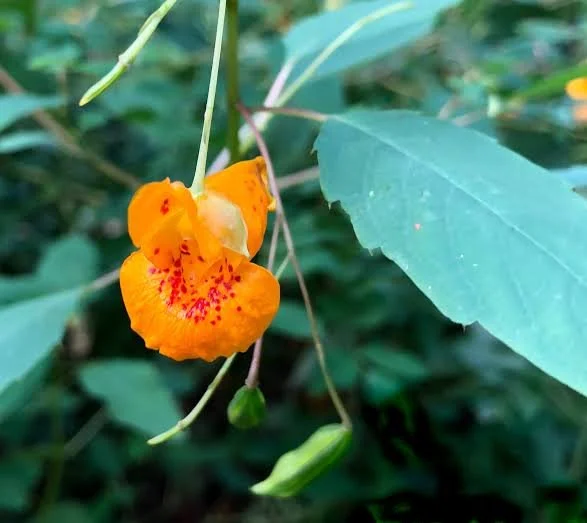
Jewelweed, AKA touch-me-not
I didn't know the bursting plant was jewelweed then, only that something had been holding so much tension in a very small package that the lightest touch was enough to undo it.
I think about that morning often now, though not for the reasons I would have guessed at fifteen. What stays with me isn't the jewelweed so much as everything around it: the waiting, unanswered questions, unfamiliar territory, and the enormous unseen power humming nearby.
A Season of Mourning
There are seasons (yes, I still say seasons without cringing) for all of us when the heart feels much like that seed pod, drawn so tight that even the gentlest touch threatens to release what we’re desperately trying to hold together. When so much is happening beneath the surface that there's very little room left between feeling and expression.
For me, this has been a season of mourning.
I’m mourning lost people and lost relationships, yes. Other losses, too. The kind that receive no flowers or formal acknowledgment. The kind you’re just meant to get over. You may know about this.
We grieve futures that quietly disappear, identities that no longer fit, and certainties we didn't realize we leaned on until they were gone. Sometimes we even grieve the life we imagined we'd be living by now.
These losses don't announce themselves; they accumulate, and one day you simply notice that the world has become unfamiliar. That you are, in some sense, fifteen again, new to a town you didn't choose, waiting at a stop whose schedule you don't yet know.
Power plants are strange neighbors. You live beside one and mostly forget it's there until some part of you registers, again, that a controlled, tremendous force is sitting just there, just across the river, doing its quiet work whether or not you're paying attention.
For me at least, grief seems to operate in much the same way. It hums in the background, shaping my emotional landscape even when I am not looking directly at it.
I've stopped trying to hurry past any of this, or bury it. Instead, I've become interested in what it's asking of me.
Making It Make Sense
For the past week, my little loom has held the first piece in a new series I've titled In Black & White.
Each weaving begins with the same neutral warp and explores in vivid color a different stage of love in some of its beautiful forms and ways: meeting, bonding, remembering, understanding, grieving, healing. The stages often exist together, don’t they? Woven through one another until it's often impossible to separate them.
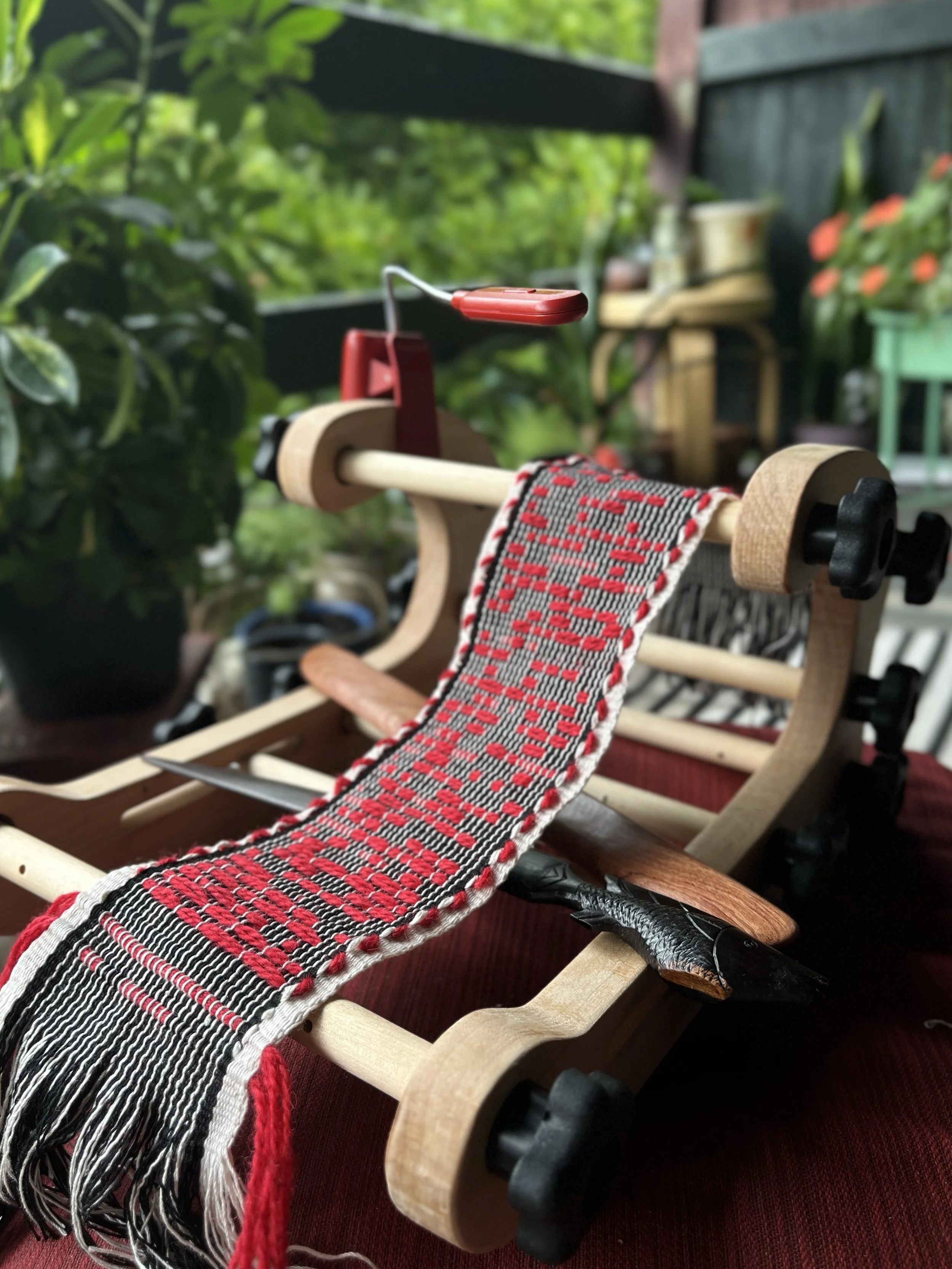
In Black & White: The Receipts (Cotton & wool, approx 4×20”)
Pictorial warp-faced weaving cut from the loom and awaiting finishing. This will be available at the First Annual Art Crawl & Auction hosted by Bald Eagle Art League in September and October 2026. More details soon.
The first piece in the collection is called The Receipts. It’s my attempt at addressing the desire to identify, name, and look honestly at what happened instead of polishing memory until it becomes more comfortable than truth.
Receipts are simply evidence. They remind us what we experienced was real, even when time begins softening the edges, and longing or shame tempt us to rewrite the story.
Weaving this piece didn't answer my questions, and it wasn't supposed to; it simply gave them somewhere to live outside my own mind.
Learning to See
At the same time, I’m also returning to painting. Years ago I painted in acrylics and sold a handful of pieces. I've been learning watercolor, which has no interest in whether I was once competent in another medium. It asks me to become a beginner again.
Naturally, that's been a gift.
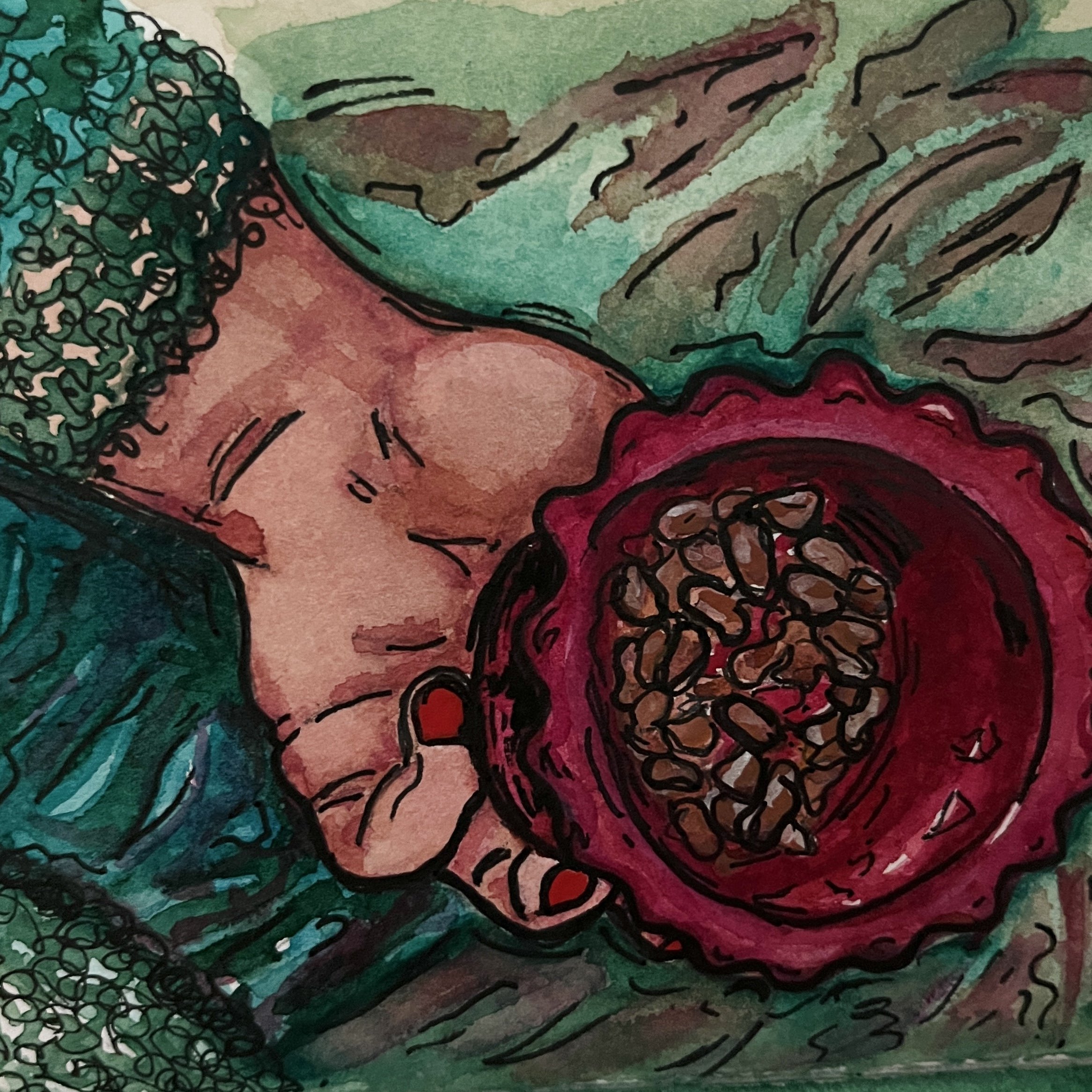
Recent watercolor journal entry. Are they peanuts, or are they rabbit turds? Turns out that depends on who is looking.
There's a line attributed to Paul Valéry: to see is to forget the name of the thing one sees. Painters understand this instinctively. The moment a tree stops being "a tree," you begin to notice the cool blue in its shadows and the warmth where the evening sun catches the bark. A white mug becomes lavender, gold, and reflected sky.
The ordinary becomes astonishingly complex through attention. Children know how to pay this kind of attention without trying. I did once, without meaning to, at a bus stop nobody used.
The Long Middle
Lately, I've had the curious feeling that the world has become very large again, like it was when I was a child. It's as though certainty has quietly stepped aside, leaving room for wonder and unanswered questions.
Maybe I’m just more willing to let go of my hold on things and watch them do what they will, understanding they were only ever going to do just that.
Our culture admires dramatic comebacks and tidy narratives of transformation. We like before-and-after photographs because they reassure us that difficult things eventually resolve.
Real life is less obliging.
Most of us spend far longer in the middle than we do at either end. Lately that's where I'm learning to sit, seeing my unanswered questions in the only way I know how. As painters do. As children do.
Jewelweed
I’m writing this during a summer rainstorm, sitting on my balcony full of greenery, flowers, and lively squirrels. I’ve come to think of this season as a kind of convalescence. It feels like an old word that suggests recovery without hurry.
Invisible work is taking place inside me, whether or not I happen to be watching the steam.
Cloud machines. That’s what I called the power plant’s cooling towers, when my young daughter asked what they were years later.
I don't know what this life chapter will ultimately make of me. I do know that as it winds down it's making something, thread by thread, color wash by color wash, sentence by sentence.
The jewelweed I touched that morning didn't burst because it was failing. It opened because it had reached its own moment, because something inside it had been quietly gathering all along, and the smallest contact was enough to send it outward.
For now, I’m content to continue convalescing. To keep weaving and moving color across white paper. To continue learning how to see.
For now, I will be a little like the riverside jewelweed, growing toward an ordinary morning.
